
The second half of the licence plate on the Volkswagen Beetle gracing the cover of Abbey Road reads 281F, interpreted by lovers of conspiracies as a cryptic clue that Paul McCartney had shuffled off this mortal coil. The reasoning, for want of a better word, was that at the time of the album’s release in September 1969, Macca would have been 28 years old if he was still alive.
“Paul is dead” is arguably the most infamous, most oft-repeated Beatles conspiracy theory. Whispers began circulating that he’d died in a road accident in ’66 and was replaced by a lookalike, a move instigated by MI5 to avoid a widespread outpouring of grief(!). Further clues included the supposed funeral procession pose the group adopted on the sleeve, the barefoot, out-of-step bassist representing a corpse. McCartney constantly laughed off the suggestion in subsequent interviews, and had a little fun with it by calling his 1993 concert album Paul Is Live.
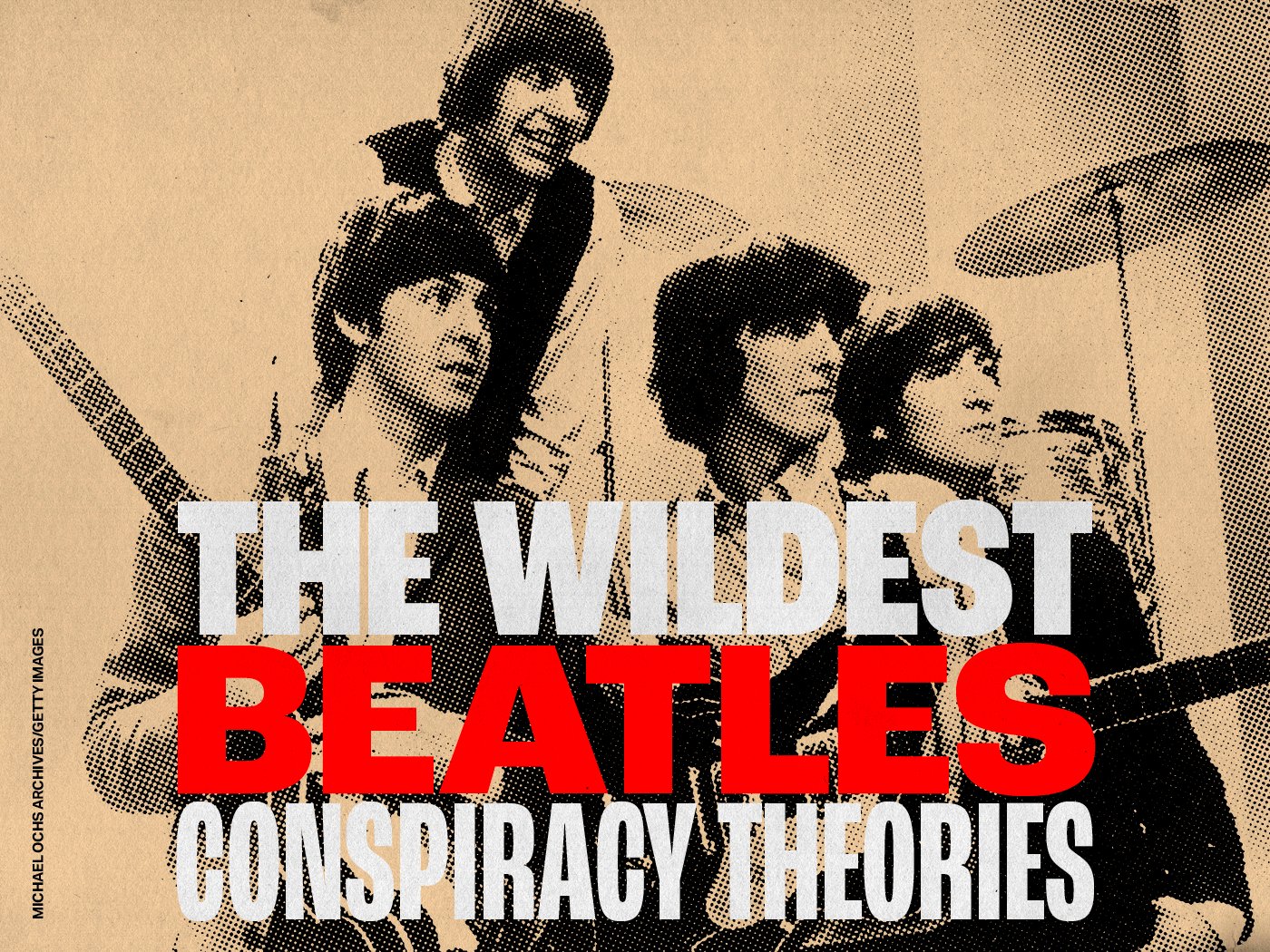
Any venture into the world of Fab Four speculation, supposition and strange assertions inevitably takes one into the territory of the tin-foil hat brigade, and while what follows may be eye-opening and/or outlandish, we must state from the outset that not everything below holds a great deal of water. It’s a frequently bizarre and dubious place, so let’s just have some fun with it.
John Lennon killed Stuart Sutcliffe
In her 2001 book The Beatles’ Shadow, the sister of the group’s first bassist claimed Lennon was responsible for his death.
“I believe the cerebral haemorrhage that cost Stuart his life was caused by an injury inflicted by John in a jealous rage,” Pauline Sutcliffe wrote. “A post-mortem revealed Stuart had a dent in his skull, as though from a blow or kick. And a few months earlier, John had viciously kicked my brother in the head in a sustained, unprovoked attack.”
Pauline repeated the accusation at an auction of Stuart’s sketchbooks in 2003, but it was dismissed by numerous seasoned Beatles watchers, including writer Alan Clayson, with whom she’d co-authored an earlier book about her brother.
“Stuart wasn’t beaten up by John,” he told The Independent newspaper. “His condition was brought on by an overuse of amphetamines.”
They came from another planet
Four aliens, captured by the US military and held at the notorious Area 51 compound, were indoctrinated by the CIA and sent to Liverpool to replace four teenagers. The extra-terrestrials were such perfect replicas even the Fab Four’s families were fooled (the originals were secretly killed).
The doppelgangers came to earth from a planet in the Orion galaxy and were, apparently, pre-programmed to meet on certain dates and ultimately share their musical talents, part of the “software” developed by the CIA for an ongoing mind control experiment. There were originally six, the tale goes, the additional two scheduled to be part of John Lennon’s pre-Beatles band The Quarrymen, but were destroyed after developing faults.
John Lennon and Brian Epstein were lovers
Stories of the guitarist and his manager having a clandestine affair surfaced in the mid-’60s, when homosexuality was still outlawed in the UK, the short holiday they took together in Spain later forming the basis of the speculative 2002 film drama The Hours And Times. Some theorists suggest Lennon’s song “You’ve Got To Hide Your Love Away” was a thinly disguised commentary on Epstein’s closeted lifestyle.
The Beatles were tools of a neo-Marxist plot
In 2019, Brazilian philosopher Olavo Carvalho claimed that all of The Beatles’ songs had been written by fellow philosopher Theodor Adorno, a leading light in the neo-Marxist Frankfurt School, in a bid to destroy western values. Writing in his book The Collective Imbecile, he said: “The Beatles were semi-literate in music, they barely knew how to play guitar.”
If Carvalho is to be believed, Adorno (who died in 1969) wrote the songs “as a means to setting up a nihilistic culture”, but carefully covered his tracks by lambasting the band in the academic magazine Akzente:
“What these people have to offer is retarded, no more than traditional techniques in a degraded form.”
Mal Evans went to his grave owed royalties for Sgt Pepper
Faithful roadie and jack-of-all-trades assistant, Evans suffered lengthy bouts of depression in later life, before he was gunned down by police in 1976 after brandishing an air rifle at a Los Angeles motel. A theory persists, repeated separately by biographers John Holmes and Keith Badman, that Evans’ condition was exacerbated by Paul McCartney supposedly reneging on an agreement to pay him for his contributions to both the Sgt Pepper title track and album cut “Fixing A Hole”, to supplement his weekly wage of £38.
A January ’67 entry in Evans’ diary reads: “Started writing song with Paul in his room. Hope people like it.”
A month later he wrote: “’Pepper’ sounds good. Paul tells me I will get royalties on the song – great news, now perhaps a new home.”
Although McCartney has never commented on the situation, his would-be co-writer apparently told friends he wasn’t credited on the sleeve because it was felt an additional name spoiled the purity of the “Lennon-McCartney” brand, and his future pursuit of monies was lost in a plethora of lawsuits when the band split.
Canadian psych-pop band Klaatu were really The Beatles
Toronto duo John Woloschuck and Dee Long never made personal appearances, nor were they ever pictured on record sleeves, their self-imposed anonymity and musical style prompting press speculation that they were actually the Fab Four under an assumed name.
The “evidence” included the fact that the mysterious, unknown newcomers had miraculously secured a big-bucks deal with Capitol Records (The Beatles’ US label), and that the band’s name referred to the alien in the 1951 science fiction film The Day The Earth Stood Still – a character Ringo Starr had dressed up as for the cover shot of his ’74 album Goodnight Vienna.
Capitol never denied the rumours, but instead issued gleefully ambiguous press releases that added fuel to the fire. The band themselves eventually set the record straight while recording their second album in the UK, the truth laid bare in an NME news story headlined “Deaf Idiot Journalist Starts Beatle Rumour”.
Stephen King shot John Lennon
Regularly doing the rounds of internet message boards, the assertion is that the best-selling author of The Shining and Carrie pulled the trigger at the behest of newly-elected US president Ronald Reagan. The story goes that Lennon’s activism had been a thorn in the side of Reagan’s Republican predecessor in the early ’70s, and the new commander-in-chief was concerned the singer’s comeback after five years of retirement would mean more trouble for the powers that be.
King was once doorstepped by a journalist who asked him straight out if he’d shot the former Beatle, and replied with a smile and a coy “no comment.” A further theory suggests that King’s playfulness when questioned led to the 1999 road accident in which he suffered serious injuries – a political plot to silence him for good.