

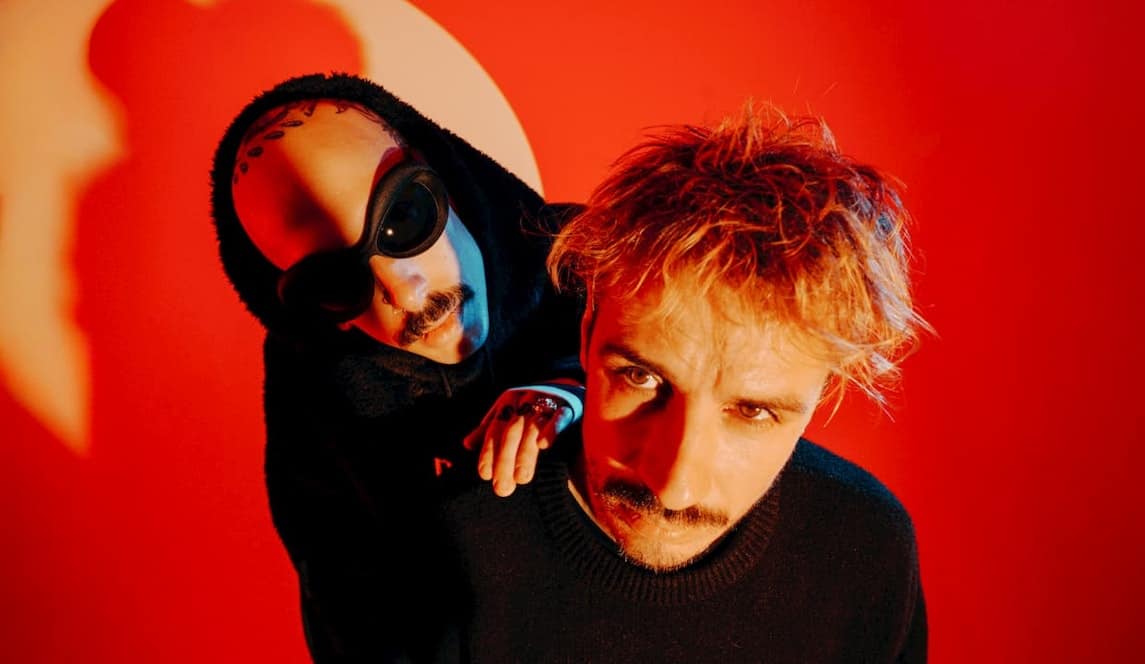
We’re here to talk about the band’s latest record, The Change Is Me– a release that feels like it’s been dragged out of the darkest corners of the mind, but somehow still points toward something like hope. Not the flimsy, Instagram-ready kind, but the uncomfortable, honest, “this might never be perfect and that’s okay” kind.
“I feel like I never reach 100% happiness,” Tim tells me, matter-of-fact. “I can be doing my favourite thing with my favourite people and still… I’m good, I’m enjoying myself, but there’s always this cloak of existential dread.”
That tension – the joy vs horror, hope vs heaviness – is where Doodseskader lives.
Scrapping the Horror Show
To understand The Change Is Me, you have to understand that Doodseskader has never been about standalone records. From the start, Tim and bandmate Sigfried Burroughs mapped out a five-part narrative.
[Year] One was “an image of who we were growing up,” the backdrop to everything. That record was their present reality at the time: messy, painful, but fighting back. Two was how the fight was going – “not super well,” Tim laughs, acknowledging the bleakness. Three was the record that pushed everything too far.
It was that third instalment that almost broke him. “I went through two atrocious years,” he says. “My brain broke, my resilience was gone. We made this record that was very real and tangible – but it was bleak. There was this emptiness, this sense of endless horror.”
When the masters came back and he reached the final track, something in him snapped. “I thought, ‘I can’t do this.’ I can’t stand on stage for two years and basically tell people: ‘It’s all horror. You’re exposed to endless horror, and I’m going to add to that.’ Then say thanks and go home. “I refuse to believe that that’s all I have to offer.”
The solution was terrifying but simple: they scrapped the album and started over. Out of that decision cameThe Change Is Me,not a denial of the darkness, but a completely different way of walking through it.
A Record for People Who Haven’t “Fixed” Themselves
There’s a trend in heavy and alternative music right now: records about overcoming mental health struggles, about emerging from the other side “stronger” and “better”. Doodseskader’s new album doesn’t play that game…at all.
Where a lot of artists offer closure, The Change Is Me offers honesty. I tell Tim that when I listen to a track like “Weaponizing My Failures”, it hits hard emotionally – the subject matter is heavy, but the melodies feel almost hopeful. “Are you trying to inspire people,” I ask him, “or is it more about catharsis for you and Sigfried?”
“I can’t choose to inspire or motivate people,” he says. “The flow of things coming out of me is what it is. We don’t sit down and say, ‘This song is going to be upbeat,’ or ‘This is the sad one.’
“We sit down not knowing what the fuck’s going on, and two hours later the song is done. All ofThe Change Is Me was written and recorded that way, two-hour bursts, because there wasn’t more time.”
He also rejects the idea of positioning himself as someone with answers. “I don’t feel like I’m in a position to say, ‘This is the way, this is how you should feel,’” he continues. “I can only show what I’m going through, what is or isn’t working for me. People can take from it whatever they want.”
Instead of promising transformation, the record sits in the messy middle-space that most of us actually live in. “For years people told me, ‘When you hit 30 it’ll all make sense,’” he says. “I was clinging to that. Waiting for this grand epiphany where I’d become the best version of myself.
“It never came. I kept thinking, ‘What am I doing wrong?’ Meanwhile people were saying, ‘You’re so lucky, you’ve got it all figured out,’ and I felt guilty saying, ‘I really don’t.’ “Then I realised: I’ve already changed so much. I’ve gone way beyond whatever 16-year-old me imagined. But I couldn’t appreciate it because I was always chasing this mythical moment when I’d finally be ‘fixed.’
“I don’t need to become Buddha. I don’t need this insane level of balance and wellbeing. I have moments of extreme happiness already. That has to be enough.”
The Change Is Mecaptures that shift – not from darkness to light, but from despair to realism. It’s the sound of someone saying: this might be me, and that might be fine.
The Live Show
One of the most striking things about Doodseskader is how massive they sound for a two-piece. On record, it’s a layered onslaught: heavy, glitchy, melodic, abrasive. Translating that into a live setting, with live drums and intense electronics, is far from straightforward. “There is a shit ton of complications,” Tim says, laughing. “In our heads we have this vision of what we want it to be, but then reality hits you straight in the teeth. “We do almost everything ourselves, and it’s borderline not feasible. We’re really cutting into our own skin to make it happen. It’s sacrifice after sacrifice.”
Gone are the days of “bass amp, drum kit, let’s go.” Now it’s laptops, complex processing, and all the chaos that comes with it.
“In the studio, I know what I’m doing. I’ll do all this stuff to the vocals so it feels a certain way. Live, you grab a mic and that sound just doesn’t appear,” he says. “So you start thinking about processing chains, routing, all that – but I’m not a live engineer, and neither is Sigfried.”
What they end up with is something Tim describes as: “The punk DIY version of a stadium show – held together by 50,000 layers of duct tape you can’t see because we’re poor as shit.”
Stuff dies in rehearsal. They bodge things together, cross their fingers, and step out on stage anyway. But for a band built on raw acceptance, that fragility actually fits. “The gear not working sometimes – that’s part of it,” Tim says. “At least it’s a live show. Life is life. Shit goes wrong.” That’s mirrored in how he approaches his role as a frontperson. “I’ve always played in hardcore bands,” he explains. “Long hair, guitar, hiding behind everything. Now I’m on stage with just a mic. No instrument, no hair veil.
“You’re watching me attempt to stand up for myself, show after show. It’s not choreography. It’s me trying to find the confidence to do it in real time.
“It feels like falling in love with playing live all over again.”
When the Record Changes You
For all the big ideas,The Change Is Me isn’t just a clever concept. It’s had a very real impact on Tim’s everyday life. “Making this record has been a life changer,” he says plainly. “I rediscovered a softer, more accepting side of myself – one that’s capable of hope and happiness in a realistic way.
“In my daily life, it’s made things so much better. I never would’ve imagined that when I was younger, playing shows and thinking, ‘This is it, I’ve figured it out.’ My outlook now is totally different.”
The process has also deepened his connection with Sigfried. “Our friendship has become even stronger,” he says. “The record really solidified the love we have for each other as people and as musicians. We want to keep giving each other more freedom – on stage, in the studio, everywhere.”
And they’re already moving beyondThe Change Is Me creatively. “The stuff we’re recording now is different again,” he says. “If you think you’ve got us pinned from this record, you haven’t.
“We’ve told people from the start: this is not a band where you can predict what’s next. Maybe one day we’ll make a full-on sludge record – who knows?
“The point is, the feeling comes first. The style has to follow whatever’s really going on with us.”
Telling the Industry to Get Bent
At some point, the conversation turns to success – that loaded word that hangs over every artist trying to build a life through their work. For Tim, it’s not complicated, but it is completely at odds with what the modern music machine expects.
“Success for us is not what people think,” he says. “It’s not, ‘We made it because this is our job now.’ Of course, surviving is important. There are families to feed. “But I’m convinced the music industry is not about music. It should just be called the entertainment industry.”
It’s clear that what matters to Tim is truth and freedom. “Success is making something real that connects,” he says. “Not just mashing up other bands’ sounds and calling it a day. “The industry rewards sameness. If you’ve got a big band, you sign 10 others that sound like them. You sell them to the same mailing list. Same playlists, same merch, same aesthetic. It works for capitalism. It doesn’t work for art.”
Doodseskader’s response has been to build their own infrastructure – including their own label. “We want to be free,” Tim says. “We don’t want to sit in rooms explaining ourselves to people whose first concern is numbers.
“We put out singles before the album that weren’t on the record, and everyone around us was like, ‘What are you doing?’ But if I wrote a book and wanted to release extra letters that expand it, no one in literature would complain. “In music, people apply these capitalist rules and act like they’re natural laws. ‘These are the chains you need to wear.’ I’m not interested.”
So what does success look like to him? “Freedom,” he says, without hesitating. “Building a platform where we can do this in a real, responsible way for a lifetime. “I don’t need luxury. I’ve been eating the same cheese for 12 years. I drive a Peugeot. I’m fine. What I want is a life of exploration – creatively and personally – with the people I love, and a way to share that honestly with others.”
Why You Should Start Your Band Anyway
As we wrap, I ask if there’s anything he wants to plug or shout out. There’s no big sales pitch. No “go stream this now.” Instead, he turns it back on the people listening.
“I’m not special,” he says. “I’m just a guy. I was lucky enough to find people who support me. “But music… music is the best thing. If you feel like you want to do it – even if you’ve never played a note – just try.
“I can’t play for shit. I keep saying it. I’m not some technical genius. It doesn’t matter. This isn’t supposed to be elitist. It’s for everyone.
“Record something on your phone. Make a noise that feels like you. Listen back to it before bed. That feeling of, ‘I made this’ – it can change your life.
“If you feel the urge to make music, just fucking do it.”