

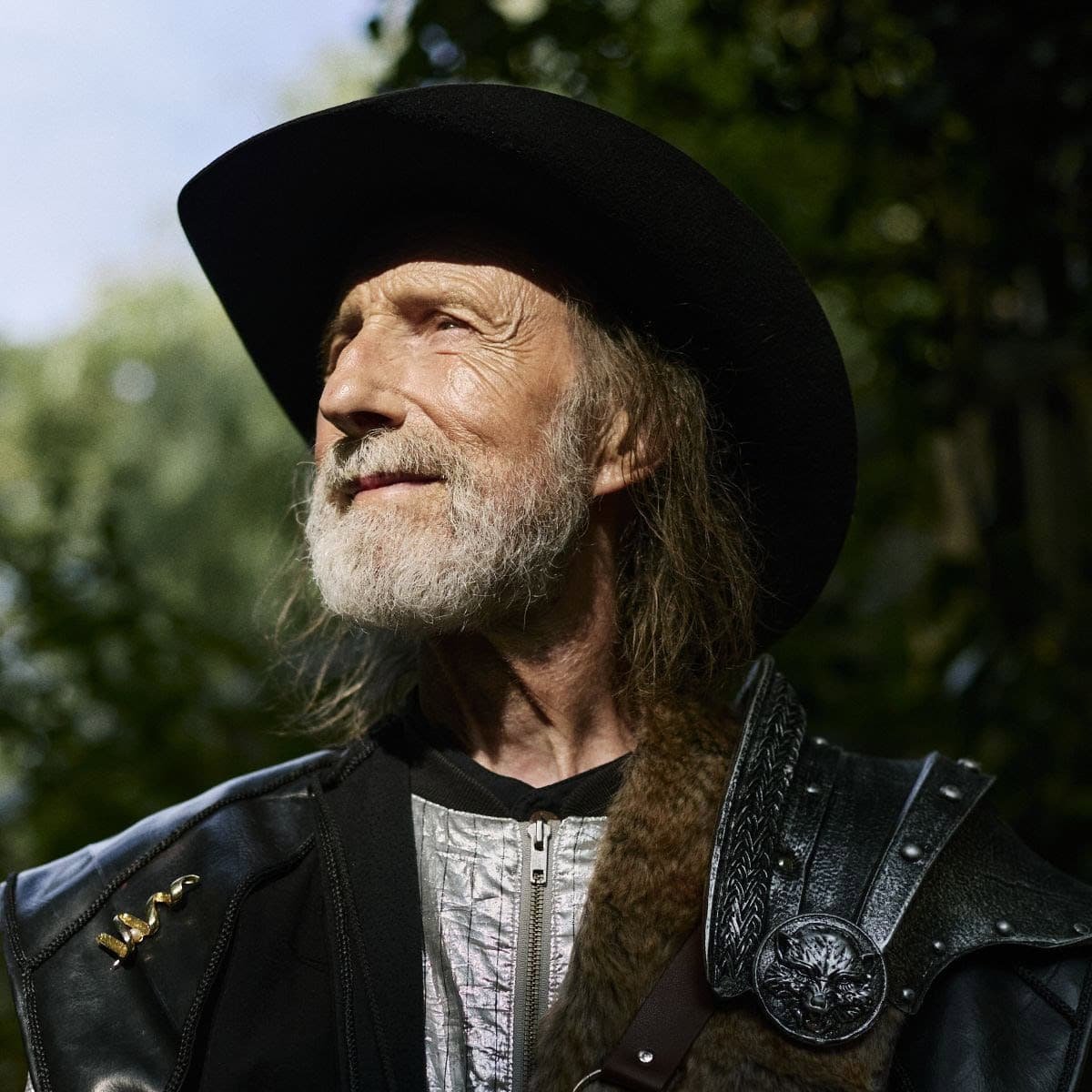
The God of Hellfire talks to Soundsphere’sChristina Brennan about new album Nature, the changing music industry, his influence on metal and why, at the age of 84, he is still determined to try something new.
Arthur Brown’s artistic influence stretches across more than six decades of rock history. The theatricality, face paint, and, yes, the infamous flaming headgear have left an impression on a range of genres, from glam and prog to metal and other music. For Brown, this longevity depends on his creative ability to continue surprising the people who come to see him.
“They want to know what you are now,” he says. “Who are you now?”
Returning to Nature
It is a fitting philosophy for an artist who has spent his career resisting any kind of pigeonholing or fixed identity. Brown’s new album, Nature, finds him simultaneously looking forward and returning to the beginning. The record is shaped by the landscape around him, and especially the North Yorkshire region that he has recently resettled in after long years away. For Brown, the distance between the young man who made The Crazy World of Arthur Brownand the artist he is today is substantial, but it is not necessarily a clean break.
“There is a different technology involved with making music,” Brown explains.“Ideas that I may have had then, some of them are now, you know, multiplied by 80 per cent, or maybe sometimes 500 per cent. It’s just enormous what is available to be used as music, used to change your philosophical standing when you’re writing the music and everything.”
And some of the technologies that are commonplace today were scarcely more than possibilities when Brown began.
“Music has explored many of the fields which, at the time I was younger, were just dreams, like synthesisers, for instance.”
The Sound of the Landscape
That mixture of difference and growth sits at the heart of Nature. Brown has returned to the landscape of his early life in North Yorkshire, and the album finds him reconnecting with the elemental world that has fascinated him throughout his career. His description of that return is characteristically Arthur Brown.
“It’s just like a salmon,” he laughs. “By the time the salmon comes back, it’s had a life. It’s been fully grown, and maybe had little tiddly salmons. And so this has also been a growth.”
Within the album, Brown incorporated sounds gathered from around his home, integrating fire and natural sounds into the recordings.
“We would take some of the sticks from outside, build a fire,” he says. “And then you get all the visual movement, and you get the crackling sound of the rhythm as the sticks are giving into the heat, and so that would become part of the rhythm track of one of the numbers there or more.”
Water received the same treatment: “The same with the water from the river,” he explains. The result was something more personal than simply sampling an atmospheric sound. “It was a wonderful way to salute nature because I did feel when we got here that I was welcomed by the plants and the trees.”
From Hellfire to Heavy Metal
It is an evocative image from the man who declares himself the God of Hellfire. But Brown’s career has always been considerably stranger and broader than its most famous image suggests. Brown mashed theatre and improvisation together in his performances long before such spectacle became routine in rock.
“The advantage of playing for a long period of years in different parts of the world, travelling, is that you play to a lot of young people,” he says. “There’s a different generation of people, or a different lot of the people who didn’t come to the first one.”
Far from existing solely on the classic-rock circuit, Brown has found an enthusiastic contemporary following in metal. “What we’re finding actually is that our greatest point of popularity, as far as live music, is the metal scene,” he says. “We play in Scandinavia quite frequently, and you hear what their history is in their music.”
And then, of course, there is the headgear. “The brazenness of the fire helmet,” Brown says when the subject of influence comes up. “I think some major bands have even worn fire helmets once, once or twice. That’s enough for them, because they don’t want to be in a conflicting challenge between fire helmets.”
There cannot be many 84-year-old musicians capable of discussing their place in rock history via competitive flaming headwear.
Music in the Age of AI
But Brown has also lived through an upheaval in how careers are made in rock. Today, gig culture and live performance have been replaced by something faster, stranger and far less predictable. Music can travel around the world almost instantly, and artists can reach listeners without waiting for a label. Yet Brown is alert to the darker possibilities of a culture in which technology increasingly mediates people’s encounters with art.
For him, the question is which values artists choose to embed in the systems now surrounding us. “Whether one feels that, say, in the age of AI, that’s a very dangerous situation” he says. “Let’s put something out there that’s valid to whoever’s listening to it, and find a system of values that will support people being worthwhile citizens, if you like.”
It is a characteristically expansive place for a conversation about a rock album to end up.
Still Becoming Arthur Brown
More than sixty years after Firemade Arthur Brown one of rock’s most unforgettable figures, Naturetherefore feels less like a late-career summation than another turn of the wheel. He has come back to the landscape where his story began, but with decades of music and performance behind him. The salmon, after all, may return to where it began. But, as Arthur Brown knows better than most, it has had quite a life on the way.
Arthur Brown’s new album Natureis released on 4 September 2026via Prophecy Productions. He will mark its release with a performance at Prophecy Festthe same day. Natureis available to pre-order now, while the latest single, ‘With a Tear’, is out now.