

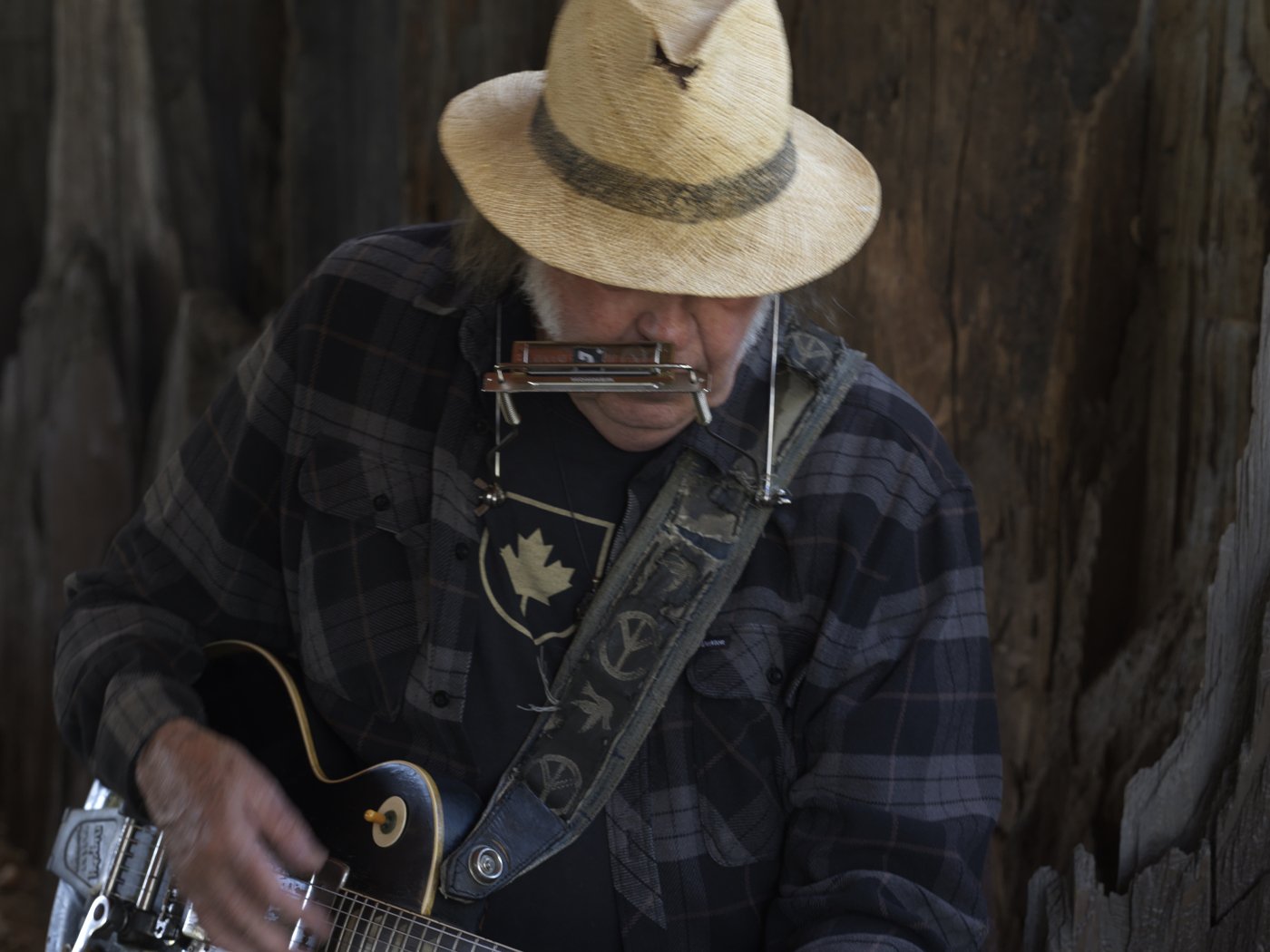
In 1989, Rick Rosas visited Broken Arrow Ranch ahead of rehearsals for Neil Young’s Freedom album. Armed with a video camera, the bass player documented the winding drive through the grounds, startling the occasional deer along the way or slowing down to let a cow cross, with the ranch house itself and Young’s infamous barn studio briefly coming into view. Nearly 40 years later, Young has repurposed Rosas’ footage to accompany “Second Song”, the title track from his new album. Unspooling against the song’s wistful, 11-minute meditation on memory and loss, it serves as a useful guide to the record itself: a meandering journey through familiar terrain. As Young’s 50th studio album, no less, Second Song carries an inevitable sense of perspective.
Recorded in a matter of days with the Chrome Hearts at Rick Rubin’s Shangri-La Studios in Malibu, California (overlooking the same stretch of coastline where Young lived during the turbulent mid-’70s years that produced On The Beach), it stacks new songs alongside material unearthed from his capacious archives, drawing together compositions and threads separated by more than six decades. Accordingly, Second Song is haunted by memories: old neighbourhoods, vanished landscapes, childhood rituals, lost melodies and the gnawing suspicion that something valuable has slipped away. Again and again, Young finds himself measuring the distance between then and now. People leave. The weather feels unfamiliar. Traditions fade.
If Talkin’ To The Trees, last year’s debut with the Chrome Hearts, was shaped by the anxieties of the present, from family upheaval to political discontent, Second Song takes a longer view. Significantly, that fascination with memory extends beyond the songs themselves. Alongside five new tracks sit “I’ll Love You Forever” and “Casting Me Away From You”, both of which have been kicking around since the ’60s (and can be found in embryonic form on Archives Vol 1). Much of Young’s latter-day work has been concerned with revisiting and reassessing his past, and this extraordinary record is part of that process. While Young has routinely carried forward songs from earlier projects, most prominently on Hawks & Doves and Chrome Dreams II, here the gesture feels especially resonant. These revived songs are more than archival curiosities: they reveal how much of Young’s musical character was already in place from the outset, with familiar melodic turns and emotional instincts resurfacing decades later in very different contexts.
Musically, Second Song occupies the same acoustic landscape as Silver & Gold, Harvest Moon and Prairie Wind – “reflective Neil”, basically – but it’s less explicitly a country record. Instead, its homespun arrangements, pensive mood and air of late-life reckoning often bring to mind Paul McCartney’s The Boys Of Dungeon Lane – another album preoccupied with place, experience and the accumulation of lived experience. Crucially, the Chrome Hearts understand when not to intrude, surrounding Young’s songs with sympathetic accompaniment that favours atmosphere over embellishment. Alongside co-producer Lou Adler, Young opts for warmth and space over the compressed sheen favoured by many of his contemporaries, allowing these songs room to breathe and their emotional nuances to emerge.
As with most of Second Song, autobiographical opener “The Foggy Edge Of Time” finds Young in mellow mood, reflecting on family, upheaval and self-reinvention as he traces the path that brought him here. The backing is sparse and sympathetic, led by Young’s minor-chord piano refrain, with Anthony LoGerfo’s discreet backbeat and occasional Mellotron flourishes from Spooner Oldham adding texture. Yet the song’s fuzzy warmth belies its subject matter, revisiting the breakdown of his marriage to Pegi Young and his departure from Broken Arrow with a candour that recalls a softened but no less devastating “Ramada Inn”, as Young ruminates, “I know now that I had to go/Leave everything I’d loved behind”. For all its melancholy, the song is less about regret than acceptance, Young reconciled to the choices that led to this moment.
“Day After Day” and “Earth Girl” feel like companion pieces, intimate and devoted in the way much of Young’s writing about Daryl Hannah has been since Storytone, the low-key solo version of which remains one of the great love letters in Young’s catalogue; but even these are rooted in continuity and endurance. “You’ll be comin’ down the stairs/And I’ll make a special cup for you”, he sings on the former, finding grace in the quiet rituals of a shared life.
The epic, 11-minute title track widens the album’s scope. Longing for a world in which people still remember how to listen, whether to birdsong, one another or the echoes of their own past, it finds Young at his most contemplative. “I need to talk to someone/Someone as old as I am/Who still remembers some of that”, he sings, looking not merely for the past but for someone with whom to share it, before imagining a gentler, more communal way of living. If the song occasionally drifts towards sermonising, its quiet, rolling melodies carry it through.
More affecting still is the astonishing nine-minute “Soon I Might Be Going”, which addresses mortality with a frankness that feels increasingly central to Young’s late-period work. Surveying a world transformed by development, environmental upheaval and political complacency, he delivers what could be construed as a farewell note, albeit one animated by curiosity rather than resignation. “If I’m not here to see it/Doesn’t mean it’s gone away”, he sings, as intermittent gusts of feedback from Old Black drift in and out of range.
Against this batch of new songs, Young stacks the two from the vaults. Significantly, neither feels out of place. “Casting Me Away From You” was originally recorded in his friend Comrie Smith’s attic in October 1965, and Young has returned to it since, lifting the melody for 1968’s “The Emperor Of Wyoming”, 1985’s Old Ways outtake “Leavin’ The Top 40 Behind” and a lyric (“We found things to do/In stormy weather”) for 1976’s “Long May You Run”. This affectionate 2026 treatment, with its jaunty clop, slips easily into the album’s fabric.
Dating from November 1964, “I’ll Love You Forever” was first recorded by Young’s teenage band The Squires in Fort William, Ontario. Here, the song’s unvarnished teenage declarations acquire unexpected emotional valency with the passing years. Musically, Young even retains the surf’s-up twang of the original; everything coming full circle, from Fort William to Malibu, only 62 years apart.
There is a pleasing symmetry in Young, on his 50th studio album, revisiting material written at the very start of his career. The frailty of his voice, worn and weathered by age, gives these songs an additional poignancy, a reminder that these reflections come from an artist advancing into his ninth decade. Far from sounding diminished, however, Young has delivered one of his most affecting 21st-century albums, equally sad and beautiful at the same time. For all the album’s reflections on ageing and loss, Second Song is sustained by what remains.