

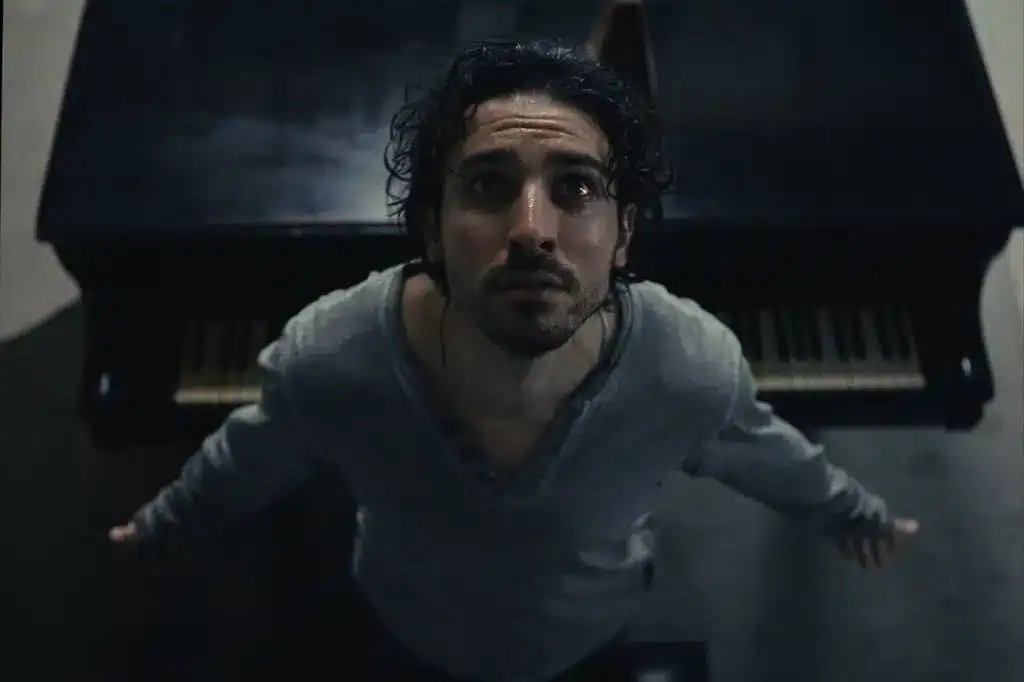
Jamie Ward stars as a troubled musician in Federico Zampaglione’s atmospheric new horror film The Nameless Ballad premiering at Tubi FrightFest 2026.
Federico Zampaglione’s The Nameless Ballad understands that creative block is rarely just about an inability to produce great art or music. Creating something momentous, whether art, music, or writing, can often be plagued by the creeping fear that whatever made you successful once might simply have disappeared. In Zampaglione’s atmospheric psychological horror, those creative anxieties become increasingly difficult to separate from a dark supernatural presence.

The Horror of Creative Block
Zampaglione turns creative writers block into an impressively claustrophobic nightmare. Jamie Ward plays Sam Gallo, a successful but increasingly fragile musician sent away to an isolated Italian villa in the hope that solitude might help him produce another music hit single. Sam initially appears to have been given the peace and space that an artist supposedly needs. However, the insolation merely turns him inward to obsesses over his very creative anxieties that he’s been trying to ignore.
Some of this experience is very true to life. Zampaglione, himself the frontman of Italian band Tiromancino, is particularly good at capturing the peculiar intensity of creativity. Close-ups of Sam at his guitar capture how an act of concentration that can become almost compulsive. Yet the screenplay, co-written by Zampaglione and Barbara Baraldi, is equally interested in what happens once those private emotions have been converted into something commercially consumable.
When Something Personal Becomes a Product
In the film, Sam’s biggest success, a song “Memories”, was inspired by a previous relationship. That history becomes a sore point for his current girlfriend, Tania (Alana Boden), who has spent years supporting him while watching a song about somebody else become his defining work. “Do you ever think about how it might feel for me when ‘Memories’ comes on the radio?” she asks.
Sam’s reply – that songs are not written according to who deserves them – is revealing. Tania’s response is even more so when she acidly observes songs get written when you genuinely feel something.
That exchange gets to the heart of The Nameless Ballad. The film treats artistic creation as something authentic that can be weaponised in a consumerist entertainment marketplace. A musician turns something intimate into a song and then the record label turns the song into a product that audiences and critics can probe and consume. Somewhere along the way, a highly intimate, personal experience can become public property.
Sam cannot escape this deal with the devil machinery at the villa. He doom-scrolls through coverage asking whether “Sam Gallo” is a future star or merely another one-hit wonder. The supposedly restorative retreat therefore becomes a highly claustrophobic experience – and it’s here that Zampaglione begins quietly tightening the film around him.
A Haunted Retreat
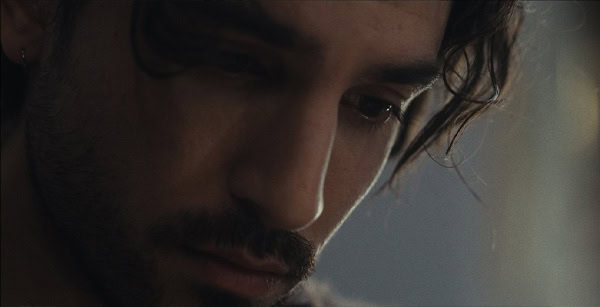
Within the villa’s grounds, Sam discovers a diary dating from 1937, filled with references to insomnia and waking dreams. An ancient piano provides another focal point. As the boundaries between past and present begin to blur, The Nameless Ballad remains deliberately slippery about what Sam is experiencing.
That ambiguity is strengthened by his history of drug use. What initially seems like a relatively straightforward haunted-house story becomes harder to categorise. Visions can be supernatural encounters or symptoms of addiction or some combination of the two.
Visually, The Nameless Ballad has a dusky, muted quality that gives even its wider spaces a strangely intimate feeling. The villa ought to offer escape, yet Zampaglione and his cinematography repeatedly make it feel enclosed. The villa’s shadowed corners gradually take on an intensely suffocating quality, while Sam’s routine becomes increasingly obsessive. The more desperately he attempts to produce something, the smaller his world seems to become.
Creativity as Possession
There are echoes here of familiar stories about artists retreating into isolation and being swallowed by the very environment intended to free them. But The Nameless Ballad gives the formula a distinctly contemporary edge. Sam is never truly isolated because the commercial world follows him everywhere. The record label wants another success, and social media always – without fail – wants another story for the algorithm.
Zampaglione turns that pressure into horror with impressive restraint. The result is an intimate and unsettling film about what happens when creativity stops feeling like something you nurture or grow and begins to feel like something possessing you.
The Nameless Ballad, directed byFederico Zampaglione, and written byZampaglioneandBarbara Baraldi premiered at Tubi FrightFest 2026.