
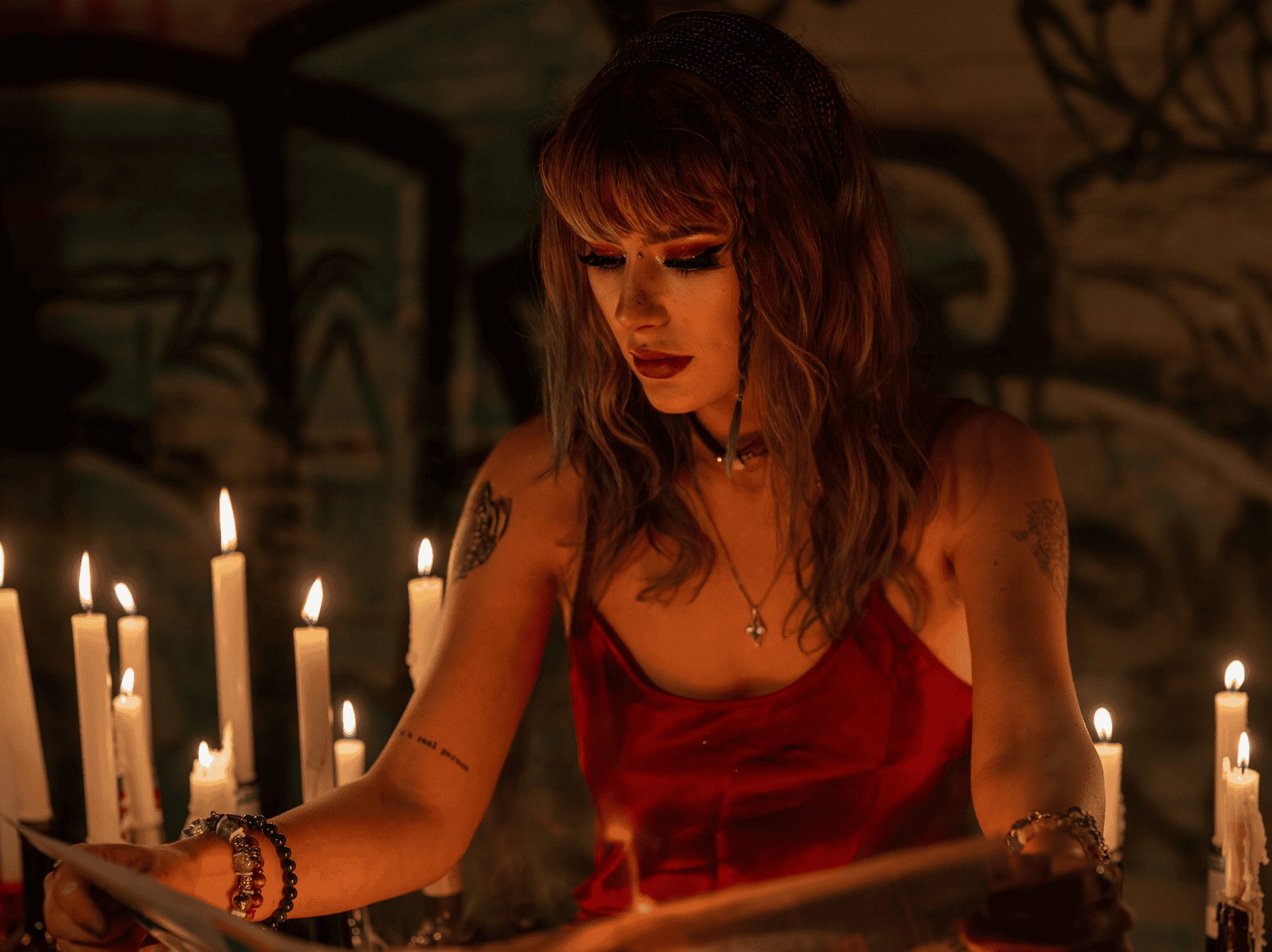
For years, Bizarre Fae – the artistic alter-ego of (now) Glasgow-based (by way of Hull) artist Andromeda, embodied that rage completely. The songs were serrated and unflinching, born from trauma, political fury and the echo chamber of the internet during some of its bleakest years.
When we speak now, it’s clear something profound has shifted. The anger is still there, but it’s tempered by reflection, by distance, and by a newfound softness that they’re no longer afraid to show. “It started out as me being angry in an attic bedroom,” they recall. “I didn’t have anyone to talk to because it was COVID. Everyone was dealing with their own stuff, and I spent too much time online, just being angry.”
Over the last six years, they’ve been trying to break up with that version of themselves: the chronically online, permanently furious personality who lived on the edge of burnout. In its place is someone who’s cautiously learning to participate in the world they once only mocked, capitalism, community, relationships, and to write from a different perspective.
That evolution is crystallised in “Real Problems”, their recent single. Originally written when they were about 21, it now carries a very different weight. “It’s a very different song now than it was,” they say. “I like it a lot more now because it’s lived in.” The rage is still audible, but the lens has widened; the track feels less like an explosion and more like a document of survival.
From Music Therapy To A Riot Grrrl Drag Persona
Andromeda doesn’t describe themself as a singer in the traditional sense. “I’m a poet who can hit a few notes,” they laugh. That distinction feels important. At every stage, words have been the anchor: first as a teenager in music therapy, then as a young adult writing their way through trauma.
“Music therapy was one of the only things that really got through to me when I was younger,” they explain. “I remember saying to my music teacher that I wished I was normal, that I wasn’t ‘tapped in the head’. He said, ‘There isn’t a single musician in the world who isn’t tapped in the head.’ That always stuck with me. We make art because we need to release things.”
By 2020, that release turned into something more urgent. They were in the middle of what they dryly call “a pretty horrific breakup” with someone who “wasn’t very nice” to them. It forced them to confront the deeper layers of trauma they’d carried since early adolescence, including childhood sexual abuse. Enter Bizarre Fae: an alter-ego, a drag persona, a protective shell and a weapon, all at once.
They describe Bizarre Fae as a character that lives in a cage in their head, one they choose when to release. In person, Andromeda is warm, a little awkward, gently spoken. Onstage and on record, Bizarre Fae is something else: feral, theatrical, a “ball of misandry” in their own words, spitting lines that cut through the kind of abuse and misogyny they experienced growing up.
“I’m not really the same kind of person that I portray Bizarre Fae to be,” they say. “People get shocked that I’m not as outlandishly confident. I am a confident person, but I’m more awkward than Bizarre Fae is ever allowed to be. She’s like a drag performance, really. There’s a lot of queer art and drag culture in how I think about her. She let me say things I never would have had the confidence to say as just me.”
Through that persona, Andromeda were able to confront subjects that had been locked away: abuse, anger, survival, misandry, power. Those early songs, raw, blunt, almost uncomfortably honest, became both a shield and a mirror.
“I hate that I felt the necessity to write some of that stuff,” they admit. “Some lyrics still catch me off guard now. I’ll hear them and think, ‘Whoa. Are you okay?’ And I clearly wasn’t. But I’m glad I wrote them. They’re proof that I survived.”
The cost, though, was high. Performing those songs night after night meant repeatedly stepping back into headspaces they were trying to leave behind. “It was getting a bit brutal singing these songs about really horrific experiences over and over again,” they say. “At some point I had to redefine my relationship with them, otherwise I was just keeping those wounds open.”
Now, they’ve managed to step back enough to see them differently. “I can see it as catharsis rather than something I was actively living in,” they explain. “That’s a huge difference.”
Hull
To understand Bizarre Fae (or at least, the history of…), you have to understand Hull. The East Yorkshire city has long nurtured its own distinct brand of alternative culture: fiercely DIY, stubbornly proud, a little bit feral at the edges. That ecosystem proved vital for Andromeda’s development.
“Leaving Hull made me love it more,” they say. “When you’re there, it’s easy to get caught up in the grey of it. There’s a lot of drinking culture. There are these vortexes where people fall into different types of addiction because they’re too busy dreaming instead of making their dreams a reality.”
Hull, for them, was both crucible and trap. It was where they found their voice, their collaborators and their sense of artistic identity. But it was also where they risked getting stuck – endlessly talking about what they wanted to do instead of actually doing it.
The Warren Youth Project sits at the centre of their story. It’s a Hull institution: a youth hub, studio, and support system for young people aged 16–25. Andromeda credits it, bluntly, with saving their life.
“If you’re between 16 and 25 in Hull and you don’t know where to start with music, you go to The Warren. Full stop,” they say. “They gave me a stepping stone into everything. Honestly, there should be a Warren in every city. We need spaces where young people can figure themselves out after school ends and there’s just this void.”
Touring with artists like Delilah Bon and sharing stages with friends from Hull’s close-knit scene deepened that sense of community. Some of their favourite memories aren’t the big moments on stage, but watching friends level up alongside them, seeing small artists they love getting recognition.
“I’m just a big fan of the community aspect of music,” they say. “Seeing my friends get uplifted, playing shows together, watching how far everyone’s come, that’s been one of the best parts. I’m a big fan of people, really, and the arts has reinforced that.”
Still, they’re honest about the need to leave. Hull is a good place to begin, they say, but not necessarily where you should stay forever. Their message to young artists in small cities is direct: make peace with your art, not with the idea of being big. Find your people. Don’t ignore your gut when it tells you someone doesn’t have your best interests at heart. And crucially, don’t confuse “hometown hero” status with the end of the road.
“Being a small musician isn’t a bad thing,” they insist. “Some of the best musicians I know don’t have huge streaming numbers. Every success I’ve had has been completely accidental and only came when I was being true to myself.”
Sex Work, Consent And Taking The Power Back
Andromeda’s story doesn’t sit neatly in the box of “musician with a troubled past”. Alongside their music career, they’ve built a presence in the sex industry, another world where boundaries, performance and power dynamics are constantly at play.
For them, sex work isn’t an add-on or a shameful secret; it’s part of a wider journey towards reclaiming their body and story after childhood sexual abuse. It has also been a practical way to survive in an industry where artists are expected to give everything for almost nothing in return.
“Sex work really is like any other job, in my opinion,” they say. “It exposes a lot more about you, sure, but being Bizarre Fae is a whole other type of scary. I’ve never really had an issue with nudity or being perceived in a sexual way, other than when I wasn’t consenting to it. So it felt like I was allowed to give myself that power back.”
They’re careful not to romanticise the industry. “You don’t make a million pounds,” they say. “It’s hard work. I wouldn’t recommend it as a career unless you genuinely love that industry and sex as a whole. It’s not this glamorous, easy money thing people think it is.”
What it offered them, though, was autonomy and stability. Compared to minimum-wage service jobs, it gave them time to focus on music, travel for work, and even support causes they believe in. “I get to donate a lot of money to charities, and that makes me feel much more at peace with my role in the capitalist cog,” they explain. “Working traditional jobs, I never had the facilities to do that, or the time.”
In many ways, they say, sex work feels less vulnerable than music. The boundaries are clearer. There’s a transactional framework; consent is explicit. “Music feels more exposing sometimes,” they admit. “With sex work, I know what I’m offering. With music, people want your whole soul.”
Crucially, sex work has helped them rewrite the script of their own sexuality. After childhood trauma, it gave them a structured space to relearn what sex could be – on their terms. “It helped me regain my understanding and relationship with sex as a whole,” they say. “A lot of people make the mistake of learning how sex works through porn, which doesn’t create healthy dynamics. Being on the inside has taught me so much about consent, boundaries, how to communicate.”
They talk about the behind-the-scenes of shoots and content creation, the consent forms, the conversations about limits, the pauses and negotiations that never make it to the final cut. It’s a world most viewers never see, but one they believe we should be more aware of. They’ve even considered making educational, behind-the-scenes content to demystify that process. “People think it’s, ‘We’re in a room, let’s get straight to spanking,’” they laugh. “It’s really not like that.”
At the same time, they’re acutely aware of the pitfalls: parasocial relationships, obsessive behaviour, the emotional toll of being constantly visible. The overlap between music fandom and sex-work audiences can be especially complex. Their boundary is simple: don’t treat them like a fantasy when you meet them in real life.
“If people come up to me in person, I’d much rather they talk about my music or about something I’ve said politically than just, ‘I’ve seen your nudes,’” they say. “I don’t go up to a lawyer I saw on TV and ask them to fight my case in a bar. It’s the same principle.”
Dopamine
As someone working within the sex industry and deeply engaged with mental health advocacy, Andromeda has a nuanced take on porn and platforms like OnlyFans. They understand both the panic around addiction and the ways these platforms can provide real connection.
“It’s no different than any other dopamine addiction,” they say. “As someone with ADHD, I know dopamine addiction like the back of my hand. Whether it’s porn, games, social media – it’s that same ‘I need a hit now’ loop. You have to learn how to regulate your own dopamine.”
OnlyFans, they note, occupies a particularly murky space when it comes to relationships. It’s more personal than conventional porn; subscribers can talk directly to creators, request custom content, build what feels like an intimate bond. For some couples, that crosses into emotional cheating. For others, it’s just part of the landscape.
They’ve seen both sides. They’ve had partners who pressured them to quit sex work, tried to make them erase that part of their life. They’ve had subscribers who just needed someone to talk to, who gradually disappeared from their inbox, and in their head, they like to imagine that’s because those people finally found real-world connection.
“I’ve had people message me saying they don’t know how to speak to women and we just talk,” they say. “Then one day they’re not subscribed anymore, and I never get to say, ‘I’m proud of you.’ But I like thinking they went out and met someone.”
It’s this tension, between potential harm and potential healing – that defines much of their thinking on sex work and porn. As with the music, they resist easy binaries. Everything is complicated, everything is human, everything cuts both ways.
Less Fury, More Feeling
So where does all this leave Bizarre Fae in 2026? Sonically, they’re moving towards a poppier direction. The claws are still out, but they’re sheathed in bigger hooks and brighter production. The themes remain rooted in feminism, trauma, and systemic rage, but there’s more space now for melancholy and acceptance.
“I don’t feel that much internal anger anymore,” they say. “I’d rather be sad about the world than angry about it. That feels like the next stage of grief. The ‘acceptance album’ is probably going to be very boring,” they joke, “but necessary.”
Alongside that, they’re nurturing AireeFairie, the acoustic folk project that frightens them in a totally different way. Those songs are quiet, rooted in nature, climate grief, gentleness. If Bizarre Fae is the scream, Airy Fairy is the long, shaky breath afterwards.
Balancing both projects, plus sex work, plus ordinary life, makes for a crowded mental calendar. But Andromeda seems oddly at peace with that. Chaos, after all, is nothing new. The difference is that now, it’s chosen.
Empowerment, for them, no longer looks like constant war. It looks like choice. The choice to step into a persona or set it down. The choice to share a story or keep it back. The choice to stay in a city or leave. The choice to survive – and perhaps, slowly, to thrive.
“You don’t have to be okay to start,” they say. “I wasn’t. I was traumatised, broke, furious, stuck in a place I thought I’d never escape. And I still made something. It wasn’t perfect, but it was real. If what I do helps even one person feel less alone – whether that’s through a song, a video, or a conversation – then that’s enough.”
For now, you can hear that journey in “Real Problems” and in the back catalogue that still hums with attic-born rage. What comes next may be less incendiary on the surface, but it’s no less radical, or creative.