


John Robb has lived several musical lives. From Blackpool punk kid to frontman of The MembranesandGoldblade, from cult journalist who helped break bands likeNirvanaandSonic Youthin the UK, to founder ofLouder Than War, his fingerprints are all over the last few decades of alternative culture.
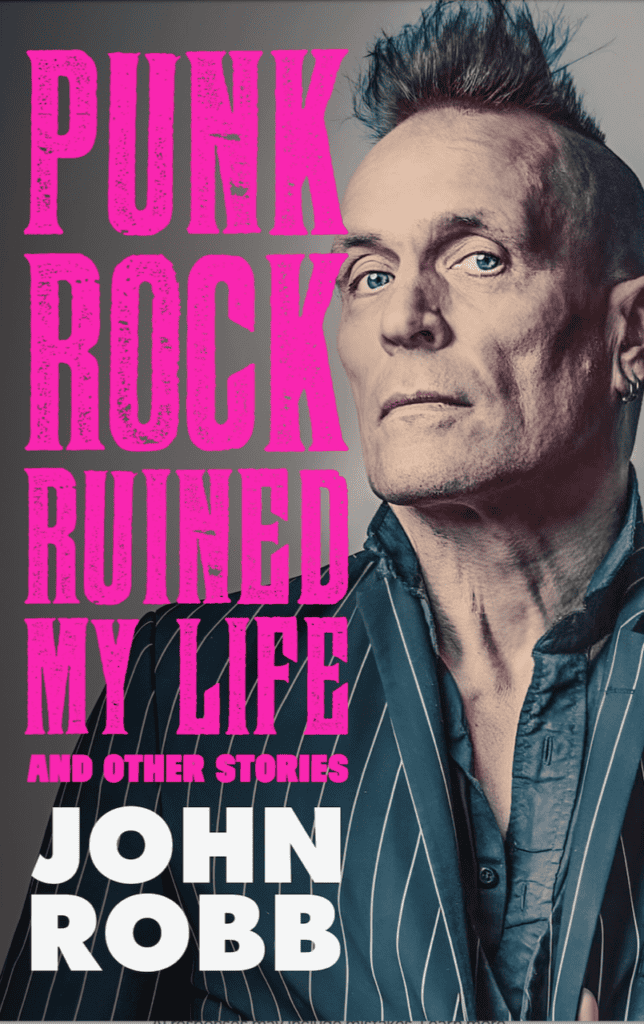
His new book,Punk Rock Ruined My Life, is not a conventional rock autobiography, and that’s exactly the point. It reads less like a victory lap and more like a long, passionate conversation in a pub, about punk, community, failure, grit, and the sheer absurd joy of having a go.
In this interview, John talks about why he writes the way he does, how punk reshaped his generation, why he refused to chase the London dream, and what he really wants young bands to understand about music, success and survival.
The Writing
One of the most striking things aboutPunk Rock Ruined My Life is its voice. It feels like sitting across from Robb as he tells stories that are vast, conversational, and full of feeling.
Robb insists that’s not some carefully engineered “style”, it’s just the only way he can do it. “I don’t think it’s an intentional style. It just is the style, and you can only do what you do, can’t you?” he says early in our chat. “You get the laptop out and start hammering away the keys, it’s only ever going to come out as you, innit?”
He’s never tried to force himself into the straightjacket of traditional newspaper prose. “That’s why I’ve never really written much stuff for The Guardianor those kind of papers, because I’m not really a journalist. I’m not a proper journalist. I’m more writing in my own style. It is idiosyncratic, but it’s not deliberate. That’s just the way it is.”
For Robb, the priority isn’t pristine objectivity or tidy structure, it’s feel. “Music writing’s great because it has no rules. You can write any way that you want. It’s good to have facts in there, yeah, but it’s more important to capture the feel. If you write about a gig, you should feel like you’re at the gig, in the mosh pit, and you still come away with a complete understanding of why that thing occurred and why everyone reacted in that way.”
That same principle underpins the book. It’s not just about Robb’s life; it’s about a mood, an era, a way of discovering yourself through strange music in small rooms.
A Memoir of a Generation, Not Just a Man
Though Robb is at the centre of the story, he’s adamant thatPunk Rock Ruined My Life is not an exercise in self-glorification. “It’s not just purely about me. The book is a memoir of a generation – a generation of people my age who were completely turned on, fucked up, whatever, by punk rock.”
Robb tracks those “little signposts” that emerged from the punk explosion – and even from the glam rock days before – and how they offered kids in provincial towns a way out, or at least a way to imagine a different life. “You know that thing of living vicariously through glam rock on Top of the Pops, and you couldn’t get anywhere near it. Punk gave you that chance, didn’t it?”
What’s striking is how he refuses to treat that past as some unreachable golden age. Yes, the book is full ofSonic Youth,Nirvana, noisy tours and chaotic scenes. But he’s quick to point out that for a 16-year-old now, the emotional experience of discovery can be just as powerful. “If you were 20 now, you’d have those same experiences. You’d be into bands like Fontaines D.C., think they’re amazing and go, ‘Can I do this? Can I have a go?’ The message since punk has been that anybody can have a go. It doesn’t mean you’re going to get a career out of it, or even be any good at it. But having a go is the best bit.”
The book, then, becomes a kind of time capsule, not just of Robb’s movements but of several decades of social change seen through the lens of pop culture. “Partially, yeah, it’s a legacy,” he admits. “But what’d be really nice is if somebody read it decades from now and got a snapshot into that period, into what punk meant for people, how it changed lives. You could see the shifts in the world and in politics, but always through music and touring and how you react to it. It’s like a micro-version overview of the end of one millennium and the start of another.”
Ego, and Knowing Your Place
Given his track record, working with huge bands, championing scenes, building a respected platform in Louder Than War, Robb could be forgiven for leaning into his own myth. But he’s almost allergic to the idea. “You should always know where you are in the scheme of things, shouldn’t you?” he says. “At the end of the day, the bands have changed generations. That’s the big stuff. You’re just a little cog in that machine, really.”
He freely acknowledges that critics and fanzine writers can have pivotal roles early in a band’s journey: “If you see a bunch of 16-year-old kids playing their third gig, you might be the first person outside that band and their mates to actually tell them they’re any good. That’s an important role, isn’t it? This kind of weird old dude who’s been around for decades goes, ‘Fucking hell, your band’s good,’ and they go, ‘Is it?’ Because no one else has ever said that.”
But there’s a clear line he won’t cross. “You can’t take credit for what they do. You’re just a narrator, telling the story or flagging it up. You’re a music fan, telling other people stuff’s really good, and trying to capture the magic. You can’t really describe a piece of music in a literal way, but you can describe what you feel about it and help other people relate to that.”
That attitude extends to how he sees music scenes, whether in Manchester, Hull or beyond. “I see it as a community, really. It’s great when people get successful and make it. All good bands should be successful – it just makes the world a better place. But there’s plenty of other bands I’ve known for decades who’ve struggled along, still making great stuff, and I still support them. It’s never just about the famous names.”
Manchester vs London
Robb’s journey fromBlackpooltoManchesteris central to the book. While many bands and writers were told they had to move to London to “make it,” he rooted himself in the North West and proved there was another path.
We talk about the way the “London dream” is constantly sold to artists. Robb laughs, noting that even in the early days there were people pushing back. “That process was already in place after punk, with people like Tony Wilson in Manchester – he used to forbid people to move to London, which is quite funny. The little fractures were there, and then it escalated in the ’80s to where we are now.”
Today, he argues, geography is less of a prison, thanks to technology and media decentralisation. “The internet means it doesn’t really matter where you are now, to a certain extent. You still have to know people to get on – there’s no point complaining about that, that’s just how it is. But it’s easier to find people. You could be on the Isle of Skye, and if you do something really good, at some point you’ll get your message out there.”
Manchester itself, of course, has gone from scruffy outpost to a genuine media hub. “Manchester now is a self-fulfilling prophecy. It’s become a massive media hub. It’s not like the ’70s when there were about 10 people in the scene and it was still more than any other city. Now it’s really escalated. The next step is to get other hubs outside in other places.”
For Robb, the important thing is that talentdoesn’t have to come from cities. “Some of the greatest music comes from really weird little cut-off towns where people think, ‘Doesn’t matter, I’m just going to do this anyway, no one’s ever going to hear us.’ They spend five years honing their weirdness to perfection, and then people find them and go, ‘Wow, this is amazing.’”
The Reality Check
One of the book’s strengths is how unflinching it is about theunsexy realitiesof band life: visas, endless touring, no money, physical and mental exhaustion. It doesn’t sugar-coat any of it – but somehow, that makes it more compelling.
Robb cites Ian Hunter’sDiary of a Rock and Roll Star as a key influence. “It was a few levels above us – they were playing 3,000-capacity gigs in America, but what stuck with me was how gritty and grotty it was touring, the grind of it. Instead of putting everyone off, it made it seem even better. It wasn’t helicopters, it was everyone with a headache, knackered all the time. It actually made it more romantic.”
His own book follows that lineage: there are labels, US tours, visa nightmares, but also long stretches of hand-to-mouth survival and relentless work.
For a generation that’s often accused of being obsessed with fame and virality, Robb isn’t convinced the core motivations have really changed. What has changed is the complexity of the industry: more paperwork, more gatekeepers in some places, fewer in others, and a touring circuit that can be brutal on small bands.
Yet his message to young musicians isn’t “don’t bother”, it’s go in with your eyes open and your heart in the right place.
A Message to New Bands: Have a Go, Build Your World
Across our conversation – and throughout the book – Robb keeps circling back to the same idea: the act of creation itself isempowering, whether or not it leads to a “career”. “Having a go is the best bit,” he says. “It’s you and your mates. You create something. It’s empowering, and maybe some other people will connect with it. That’s the powerful thing.”
His advice to young bands is ultimately about intent and community. Don’t sit around waiting for London or any external “industry” to validate you. Build your own world where you are. Accept that it will be hard – that there’ll be bureaucracy, disappointment, long drives and empty rooms, but don’t let that put you off. Remember that you’re part of a wider, ongoing story, not the only story.
In the end,Punk Rock Ruined My Lifeis less a cautionary tale and more an invitation – to join a long, messy, beautiful tradition of people who let music derail their lives in the best possible way.
And if you’re a kid in a small town, wondering whether to start that band, zine or DIY night, John Robb has already given you his answer: yes. Have a go.
Buy John’s new book here: https://www.amazon.co.uk/Punk-Rock-Ruined-My-Life/dp/1526191784