

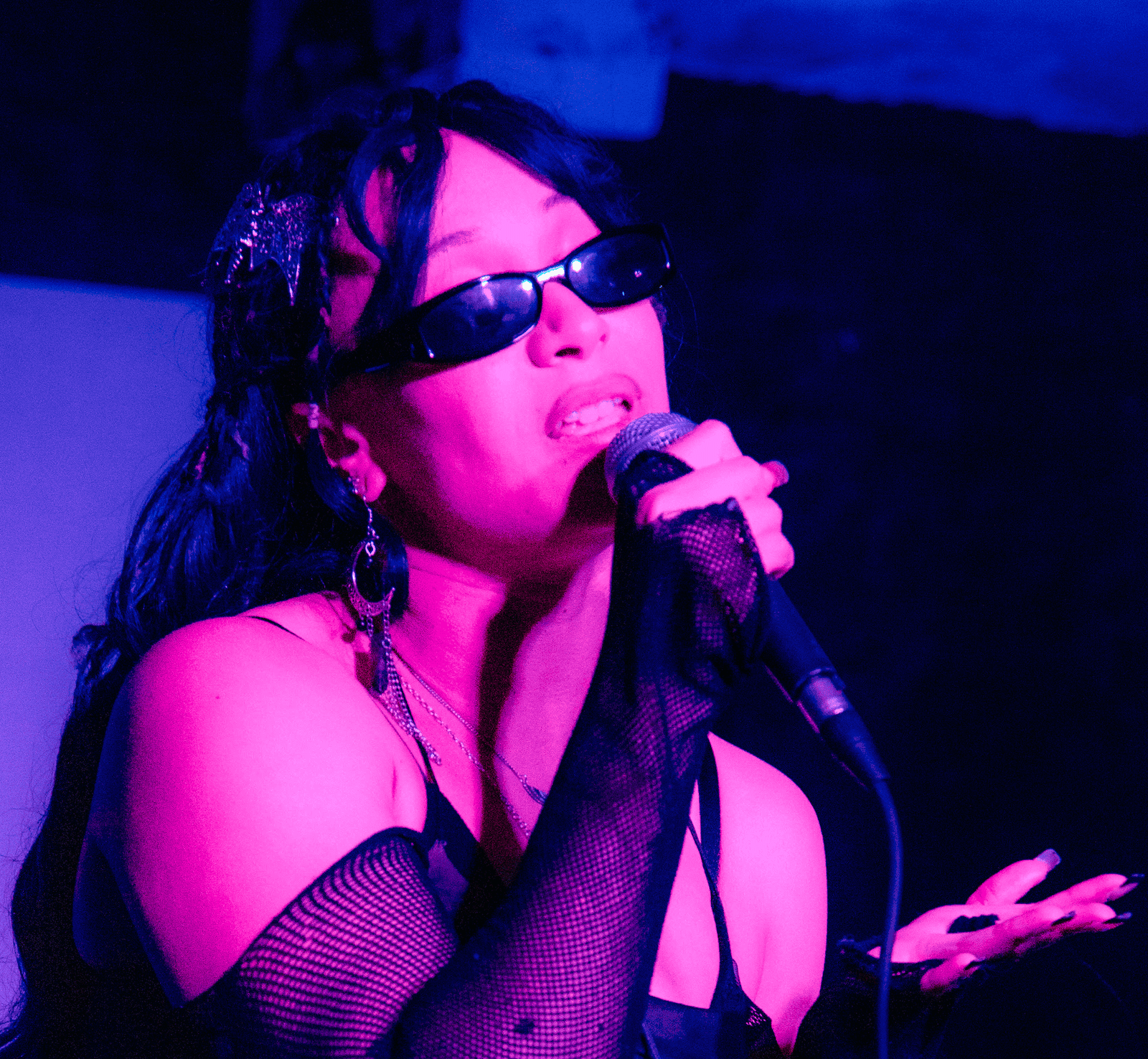
The poet-turned-producer on fairy lore, freestyling from her bed, and throwing up after every gig.
There’s a version of Tyra Aqua that exists in the popular imagination, cool, mysterious, winged, faintly menacing, the kind of creature you’d meet at the tree-line and regret following. And then there’s the artist herself, who will cheerfully tell you she’s a “chatterbox,” a Skyrim obsessive, and someone who views her friends as Sims characters.
“I’ve had people where they’ve been thoroughly disappointed upon meeting me and realising I’m not cool at all,” she laughs.
That gap between persona and person is, in a roundabout way, the whole story.
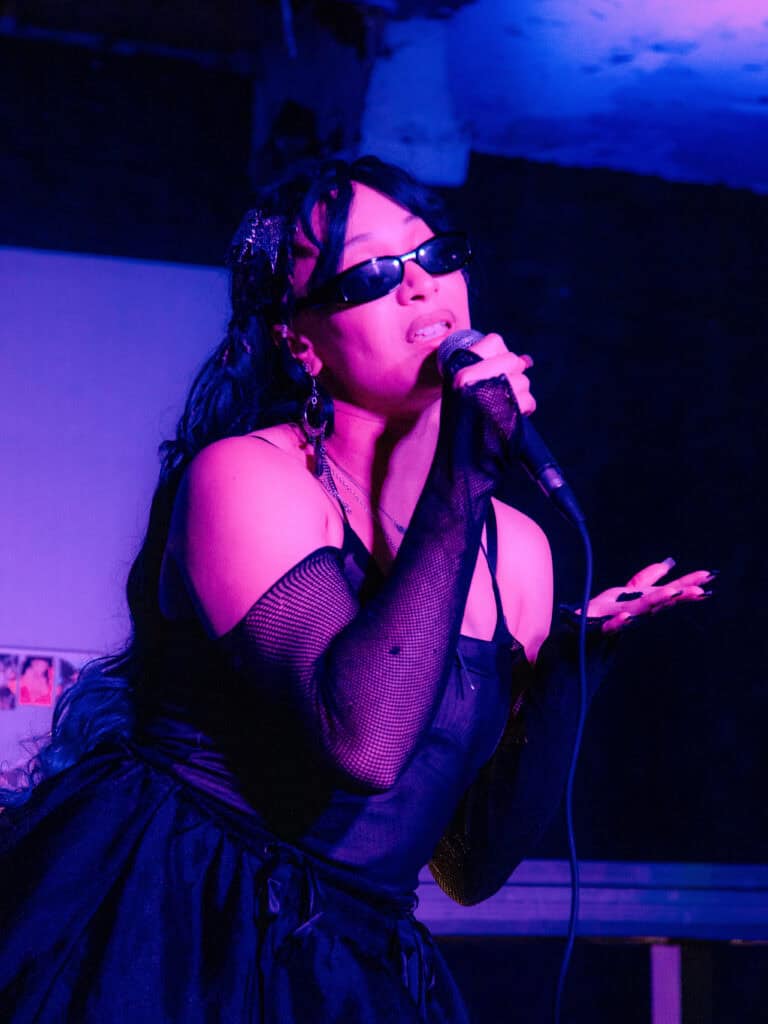
Tyra Aqua – credit: @wnwrd
From poetry to trap beats
The name came first, and it wasn’t a music project at all. “I used to write poetry. That was Tyra Aqua — it was like my poetry name, because I’m really bad at expressing my feelings,” she explains. “My friends used to call me the Ice Queen because they say I’m really cold and shut up. And poetry just was me expressing how I felt when sometimes I’m not very good at that”
Music was always around: “I was raised in a household where there was always music playing”, and the poetry eventually curdled into lyrics, the lyrics pulled in production, and the two worlds collided. Her original plan, tellingly, was to stay invisible: “At first, I wanted to be a ghostwriter. I didn’t even want to be the face of anything.” The industry, in its infinite wisdom, wouldn’t have her. “No one wanted to work for me because I didn’t have anything to prove that I would be a good ghostwriter. I was like, ‘how do you break into that?’ Then, I was like, ‘Oh no, I love this!’”
The ugly thing nobody says
Ask about influences and you get a list that shouldn’t cohere but absolutely does. Emo rap sits next to trip-hop sits next to rave culture sits next to the dark-wave and post-punk she’s currently deep in.
The emo rap thing is the one that surprises people, because the output doesn’t sound remotely like it. “It’s weird because I don’t make emo rap. I’m not an emo rapper,” she says. “But I just like how raw and vulnerable and sometimes repulsive their lyrics can be, saying the thing that nobody else really wants to say because it doesn’t sound good” .
That instinct predates the singing entirely. “When I first started producing, I was making a lot of trap beats because I actually used to rap. I didn’t even used to sing. I used to go on these beats and I used to say all these ugly thoughts in my head, and that was like a big start.”
Then there’s the rave, and the community element. “I love how you can connect with people in a rave, and it’s like you get all these feelings and emotions, and you just can’t even talk to each other. You’re just dancing.” And trip-hop, which is practically hereditary: “Both my parents are Bristolian, so I was raised around a lot of that music.”
The result is an artist allergic to categorisation. “I don’t want to put myself in a box or a genre. I just want to make music that I like.”
‘Final Fantasy’ and the bubble of nothingness
If one track explains her, it’s Final Fantasy, a song about dissociation written roughly two years ago, during a period she describes with unnerving precision. “Dissociation is like you’re wandering around and the world doesn’t even feel real. You don’t even feel like a real person. You just feel like you’re floating through in this hazy moment of, like, am I even here?“.
At the time she’d gone quiet on everyone. “I had people getting on me like, ‘why are you not replying? Why are we not hearing from you?’ And when I wrote that song, that was me trying to explain, I’m actually so locked in on this bubble of nothingness. I can’t think about doing the other stuff, because my brain’s not here right now.”
The song’s real subject is blunter still: “It’s basically about how I’m terrified depression will ruin every relationship I have. Even if I conquer this, I might have ruined everything by then.” She started therapy around the same period. It’s her favourite thing she’s made, “not even musically, but just from a personal level of what it meant at the time to write and release it.”
Writing, she says, works as a kind of self-surveillance. “Sometimes I won’t even know I’m upset, and then I’ll start writing the song and I’m like, oh, I’m really struggling with this thing…”
Fairies and Terry Pratchett
The fae imagery around the artist isn’t an aesthetic bolt-on. It’s childhood, recovered. She was reading chapter books at four, devouring Terry Pratchett, getting sent up to year six lessons in year one. “I was reading through the walls. They couldn’t really keep up with me”.
“I was always obsessed with fairies, this idea of these alternate, menacing, mischievous little creatures that live in the forest. If I lived in a mythical world, I would 100% want to be a fairy.” Coming back to music meant coming back to that: “I reconnected with my child self.” Her debut single was, fittingly, called The Fairy’s Curse. “I was like, I’m ready, let’s go.”
Early on, Tyra Aqua was armour. “There’s me, just Tyra, and then there’s Tyra Aqua, who is me supercharged, if I was an EV Pokémon, Tyra Aqua was like Sylveon.” Crucially, it let her do terrifying things. “I couldn’t go on stage as Tyra. That’s terrifying. I used to cry in school plays. But Tyra Aqua can.” Twitch, she says, has since blurred the two.
Do it scared
Which brings us to stage fright, a subject she approaches with almost alarming honesty. Ninety per cent of her shows are done stone-cold sober. There’s no ritual, no Dutch courage. “I’ve been living with the mantra of do it scared. Do it terrified,” she says. “Most of the time I perform, I get off stage and I throw up. But I do it, and I still do it”.
What powers her through is, improbably for a self-described “massive loner,” other people. “I get people come up to me afterwards and they’re like, I really connected with that song. The fear is always going to be there, but the good stuff would never happen if I didn’t push through.”
From the bedroom to the world
She is, emphatically, a bedroom artist. “It’s written in my bedroom, recorded in my bedroom, probably mixed in my bedroom.” The process starts with drums, trap drums, always, regardless of genre. “I will find a way to sneak some influence in somewhere.” Then she freestyles. “Ninety-nine per cent of how I start things.” On a good day she’s at the desk and the mic. On a bad day: “I move my entire setup into my bed. All my favourite sad songs were written from my bed.”
She then mines the freestyle for keepers, sometimes a whole track (Final Fantasy is essentially untouched), sometimes a single hook, and raids her notes app of poems for the gaps. Only then does she produce properly: “I go back and produce again because I then know what the song is about, to be able to add the highs and lows.”
The magic, she reckons, is in not planning. “You don’t know what part of your brain you’re going to access, because you don’t really have time to think.”
Media bleeds in constantly, Twilight, Vampire Diaries, Skyrim, and one love song about the Grim Reaper based on a character from The Sims. “I view people as Sims,” she admits. “If I can remember all my Sims’ traits and when their birthday is, I should probably remember yours.”
The Frankenstein’s monster
Asked to build her sound as a stitched-together creature, she obliges with relish: the heart of Deftones (“I love a yearning song, and they love to yearn”); half a brain of XXXTentacion for the emotional side, “the way he used to talk about his experiences with mental health”; the hands of Grimes, “part of the reason why I produce myself”; the mouth of Doja Cat, “because I’m always posting memes, nothing I ever say is ever serious”; and the shoulders of Scarlxrd, “on stage seemingly the most confident person, and then actually secretly kind of a dork. He’s also a streamer.” A final addition is added post-chat, with additional enthusiasm: “PinkPantheress because of how she launched her career through social media and that’s kind of what I see for myself. I love being online, I love finding artists online, and I love people finding me online.”
Small, close, peculiar
Her current focus is twofold: A Drive, a collaboration with US rapper Tavell Jectx — a partnership built entirely remotely, and all the better for it (“what are my weaknesses are his strengths”) — and Twitch.
The community there is the thing she gets most sincere about. “I don’t have a massive group, but the people that I have, it’s the cutest. We play Minecraft together. It’s a small community, but it’s a close community of kind, lovely, very nerdy, weird, strange people with peculiar hobbies.”
“I’ve always felt very misunderstood my whole life. And getting this feedback from a group of people like, yeah, we get you, you make sense — that’s really changed my perception of myself.”
Not bad for an Ice Queen.