

From the long road between La Petit Mort and La Grande Mort Or Silence Of God to his refusal to let anyone else define success, David Gunn talks about making art from life, and following the work/music wherever it leads.
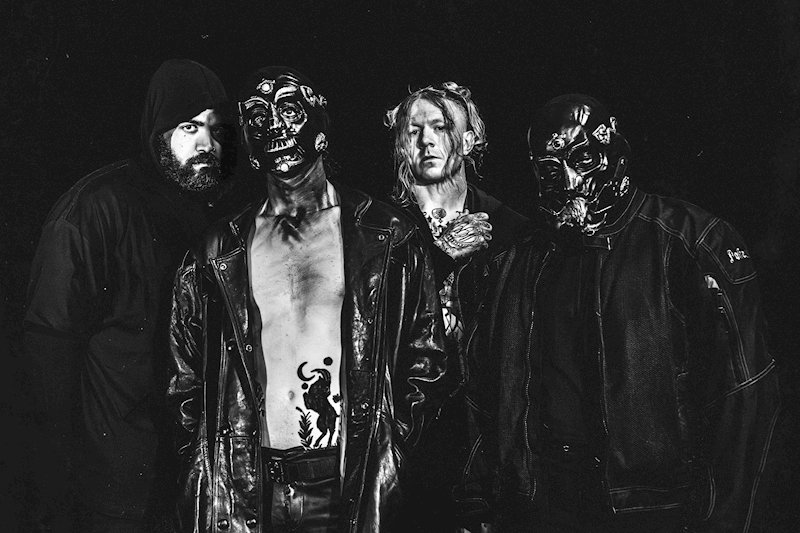
King 810 have never been easy to squeeze into a single story. The band’s reputation has often travelled ahead of its music: Flint, Michigan; guns; violence; heaviness. But David Gunn sees a much broader history, one that includes acoustic passages, spoken-word poetry, big visual ideas and records that don’t sit neatly inside a genre or a headline.
“I tend to think that it’s more what everyone decides to focus on rather than what we really are,” he says. It’s a perspective that runs through our conversation about King 810’s history and the band’s new album, La Grande Mort Or Silence Of God, due on 27 November 2026. Gunn isn’t interested in making a record to correct anyone’s assumptions. He’s interested in following the work. “I am for sure going [on the journey], and I’m going with or without anyone’s company,” he says. “If you would like to come, that’s good, but I don’t want to force you.”
A record that arrived in its own time
The album continues a creative thread that began with La Petit Mort, but Gunn is careful not to frame it as a sequel made to satisfy expectations. King 810’s work, he says, has always had a universe of its own, one that can stretch beyond the space available on a single release.
“We kind of created this universe that it’s a bit expansive,” he explains. “Some things are, you know, shorter chapters to the whole work, but some things take a lot more.” La Petit Mort was one of those bigger undertakings. There was more to it than could fit, but the fact that more material existed didn’t mean a follow-up had a set date.
A record’s success, or the popularity of a particular song, doesn’t automatically determine whether there will be a sequel or prequel. “It really doesn’t have anything to do with that. It’s more about the piece itself.”
For a long time, the next part was simply somewhere out of view. Gunn says that La Petit Mort contained a musical motif belonging to a song the band had never released. “There’s a motif on LPM, the record. It belongs to a song that we’ve never released.” It was a thread left hanging, though not one he spent years actively trying to pull. He had visualisations and knew there was more to come, but his approach was to keep busy until the work returned. “If I know something’s coming, I know it’s going to arrive when it arrives,” he says. “I don’t sit and wait. I just kind of stay busy until it comes.”
When the material did resurface, it came with a sense of surprise. Gunn recalls going back through old files, writing, demos and songs, and realising there was unfinished work among them. He places the album’s arrival around spring 2025, though he admits he doesn’t remember precisely when it began to come together. What matters is that it arrived when it did, not according to a plan laid down a decade earlier. “It could have been 20 [years],” he says of the gap between the connected records. “I didn’t know when. It could have been three months afterward. We would have got it, but this is when we got it.”
The writing itself, once the time came, was quick. “It was super easy to write,” Gunn says. “It was over within a week, and it arrived.” That sudden burst was made possible by the years that came before it. Gunn says he couldn’t have understood the record a decade ago—not because he lacked experience as a musician, but because he hadn’t yet lived through the experiences that now inform it.
“I wish this one came sooner,” he says, “but in a way I’m glad that I didn’t have these experiences sooner.” He is stark about what that might have meant: “That would have ruined my life even more if I were in my 20s and these things happen to me.”
A relationship seen from every angle
The personal history behind the album is central to how Gunn describes it. Rather than a set of disconnected songs, he sees it as a series of perspectives on a relationship. “The songs are kind of a panopticon of different perspectives to look at this same occurrence, which is the relationship between these two people,” he says. “Love Kills,” one of the songs discussed in the interview, is “just one angle of that.”
The track, Gunn says, is personal; the lyrics and video are closely tied to the story behind it. Its subject also connects to an interest that has been present across King 810’s catalogue: the relationship between love and death. “If you’re not obsessed or fascinated, if you want to use a nicer English way of putting it, by love and death, you’re dead,” he says. “What else is there to be fascinated with, sports cars?”
He traces those themes back to the band’s first record, Memoirs Of A Murderer. The title brings death into view immediately, while the words “King is Love” appear in the inside artwork. On that album, Gunn says, love takes the form of camaraderie and sacrifice: “the love of another person so much that you die for him or give your life for him.” The next record, La Petit Mort, moved into emotional and physical love. “It’s called La Petite Mort. You open it up. There’s a naked woman. There’s nothing subliminal here. It’s pretty straightforward.”
For Gunn, those subjects don’t automatically make the music miserable or angry. “Misery is just another side of a coin,” he says. “It’s just a thing that comes with the human experience.” He also pushes back on the assumption that screaming must mean anger. “What if I’m not angry about anything? What if I just feel strongly about something? What if it’s a passion?”
The album doesn’t necessarily resolve the relationship at its centre. Near the end of the interview, Gunn hints that the record leaves something open: “You’ve heard the record, so you know how it ends, and you know it doesn’t necessarily end with some resolve. So there must be something more behind it, right?” He doesn’t spell out what that means. The lack of a neat ending seems to be the point.
More than the headlines
That sense of feeling, rather than any one fixed sound, is part of why King 810’s shifts in tone matter to Gunn. The group is often described through its heaviness, but he argues that the softer, more experimental parts of the catalogue have been there from the beginning. He points to an acoustic track on Memoirs Of A Murderer and the quieter back half of that record, as well as the softer second half of La Petit Mort. “King hasn’t necessarily been a brutally heavy band since the beginning, in my opinion,” he says. “It never wasn’t that way.”
He makes a similar point about the band’s first album containing around 15 minutes of spoken-word poetry. That didn’t become the dominant description of the record; the heavy material did. For Gunn, that’s an example of how a public narrative can narrow what people hear. When people describe King 810 as a heavy metal band and then act surprised by a different kind of record, he says, “What it really sounds like to me is you thought we were [a metal band]…”
The same frustration applies to coverage that centred King 810’s use of guns and their origins in Flint while overlooking the rest of the band’s work and live shows. Gunn remembers performances that included dancers, mud and other theatrical elements, but says the press often focused on the imagery that generated the simplest headline. I [Dom] chime in here: “People were like, ‘King 810 are a violent band’ because that’s what sold and that’s what got the clicks, and nobody was really listening.”
Gunn himself has little interest in feeding that cycle or providing a new angle on demand. “I’m waiting for them to make up a new angle about us,” he says. “It’s not on me to kind of feed people [journalists and listeners] the talking points that they should be doing.” His focus is on making the next record, not persuading everyone to agree with his version of the band.
Real instruments, real voices, unfinished business
David describes La Grande Mort Or Silence Of God as an album built from a wide range of live performances and instruments: “real brass, real horns, real strings, real cellos, real double basses, real women singing, real men singing.” There are “big woodwind sections” on some tracks, too, as well as “a real clinician, a real therapist speaking to me.”
He offers those details while reflecting on “AI and this strange world that we live in,” emphasising the real people and instruments on the record. The list also reinforces the album’s breadth: this is a relationship story told through more than one sonic language. Gunn jokes that listing all these elements may not sound like a conventional sales pitch, but the production details are part of how he wants listeners to understand the album’s character.
Success on his own terms
Gunn’s idea of a journey is just as open-ended. He says he will keep moving with the work, whether or not an audience comes along. Listeners are welcome, but he won’t steer toward a safer or more predictable destination just to keep them comfortable. “I’m going to go regardless of where it leads,” he says. “Don’t hold me responsible for the places we end up.”
That conviction has helped shape a career that doesn’t seem to depend on any single market, venue size or measure of success. King 810 have played smaller cities and rooms where there may only be a couple of dozen people in attendance. Gunn says the band still plays the same show. “Of course, you want a whole Madison Square Garden packed out,” he says, “but none of it really bums me out.”
He doesn’t pretend music is the obvious choice if money is the priority. “I wish I would have thought of something else for money’s sake,” he says. But he also doesn’t define success through sales figures or external validation. “I’ve already decided I’m successful,” he says. “My success isn’t contingent on some external validation.”
For Gunn, success can be found in a person at a show, or in the stranger who discovers a song without ever meeting the person who made it. “This really to me seems like magic,” he says, describing the experience of creating something at home and putting it out into the world. “Right now, a person I’ll never meet is discovering it right now as you and I talk.”
That possibility matters to him more than being remembered by name. Asked about legacy, Gunn says he doesn’t care whether people remember him, but hopes the work survives long enough to reach whoever needs it. “Just find the pieces of you they’re kind of attracted to you. They’ll find you,” he says.
It’s a fitting thought for an artist whose songs, in his own account, grow out of experiences that recur, change shape and sometimes take years to find their way into the open. La Grande Mort Or Silence Of God is another piece of that ongoing work: connected to La Petit Mort, but shaped by a life lived in between; full of different perspectives, real instruments and unresolved feeling. Above all else, King is love.