

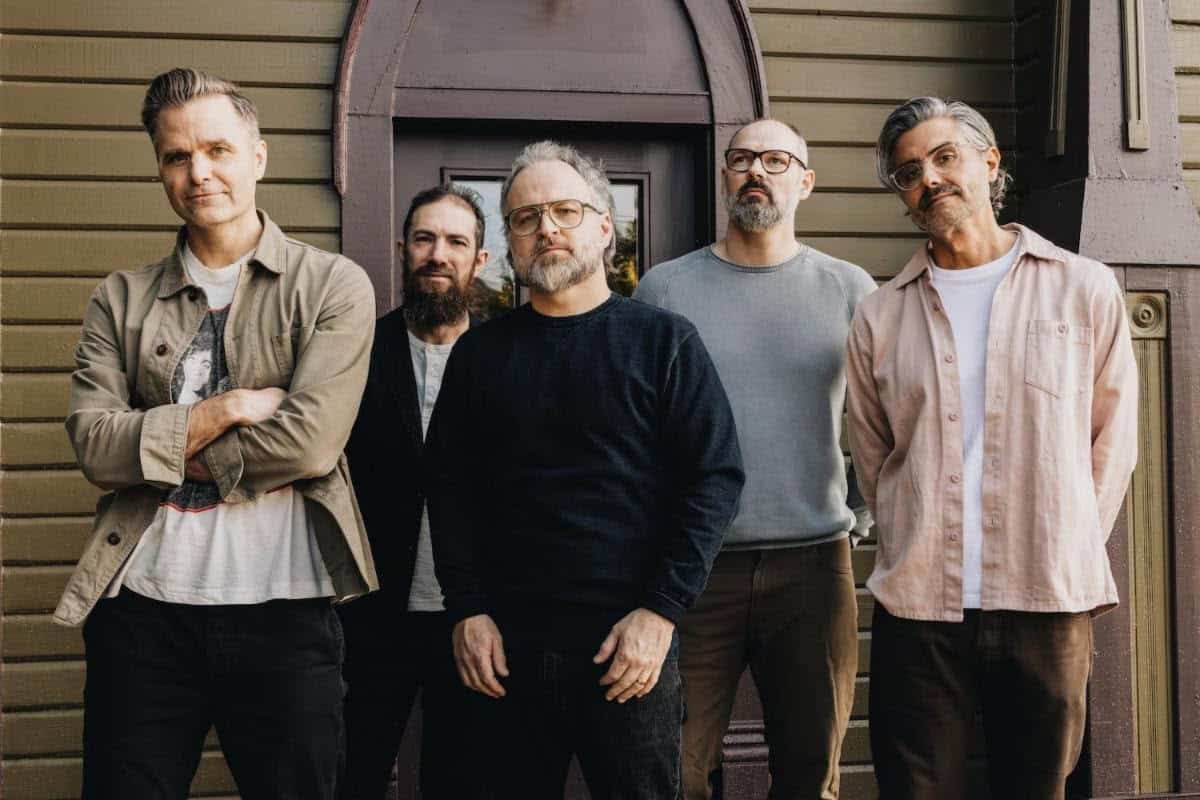
For bassist Nick Harmer, that simple fact – survival, in all its mundane and miraculous forms – has become the real measure of success. Not the plaques, not the streaming numbers, not the festival font sizes. Just the continued ability to make music with his closest friends, to step onto a stage and feel that old Death Cab electricity flow.
On the band’s latest record, I Built You A Tower, Harmer and his bandmates lean into that reality with a calm confidence that only comes from time served. It’s not a victory lap, and it’s not a nostalgia piece. Instead, it feels like the sound of a band who have finally made peace with their own reflection, and decided they quite like what they see.
This conversation with Soundsphere finds Nick talking about Tower, the weight and wonder of “legacy”, streaming-era chaos, and what it means to stay uniquely Death Cab after all these years.
The Death Cab Legacy…
Ask most bands about “legacy” and you’ll see the squirm. The word suggests endings, monuments, and a kind of museum-ification that’s death to any artist who still feels they have something to say.
For Harmer, that tension used to be very real. “We’ve just been so kind of myopically focused for so many years,” he reflects, talking about the classically unglamorous cycle of writing, recording, touring, repeat. For a long time Death Cab were simplydoingthe thing – head down, album after album, show after show. Then 2023 rolled around, bringing with it some big anniversaries, big tours, and a stark realisation.
They hadn’t just made a run of important records. They’d quietly become one ofthose bands. Indeed, somewhere betweenSomething About AirplanesandTransatlanticism, between the early Barsuk days and festival main stages, Death Cab for Cutie crossed the invisible line from promising indie darlings to a group with a proper canon, and now, new fans are discovering them the way a previous generation discovered The Cure or The Smiths.
Rather than flinch, Harmer says the band has chosen to embrace it. He suggests they could be so lucky to have “legacy” apply at all – and to still be here, functional, making new music that excites them, while people continue to stumble into their world for the first time.
That gratitude runs deep. In an era that chews through scenes, trends and bands at frightening speed, Death Cab’s steady persistence feels almost radical.
From Friends To Family…
When you’ve spent thirty years in the same band, your life isn’t neatly divided between “real life” and “band life”. The lines blur, then vanish.
Harmer talks about his evolution as a person and a musician not in terms of technical milestones or career peaks, but in terms ofrelationship. What started as four friends in a van has grown into something far stranger and more intimate.
Over time, those friendships became business partnerships. Tours, contracts, advances, budgets – all the stuff no one dreams about when they pick up an instrument. Then, somewhere along the way, even that label stopped fitting. Now, he says, what binds Death Cab together feels closer tofamily– woven into every corner of his life, impossible to separate from who he is day-to-day.
With that comes a twin realisation: he knows both more and less than ever. As a younger player, Harmer admits he carried a certain cockiness – the sense that he more or less “had it figured out” as a bass player in a guitar band. Three decades of playing, touring, learning and listening have flipped that feeling on its head. Now, the more he understands about his instrument, arrangement, feel and space, the more he’s aware of the gaps.
It’s a humbling place to be. But it’s also where the best art often comes from – that combination of uncertainty, curiosity and quiet confidence. Crucially, while he feels less sure of himself as aknower, he’s more certain than ever ofwho the band is. Death Cab know what they’re good at. They know the emotional register they occupy and what people come to them for. They’re no longer second-guessing their right to be themselves.
That clarity hangs overI Built You A Tower – not as a limitation, but as a kind of anchor.
Commercial Success, Or Just Doing The Thing…
One of the most striking threads in Harmer’s reflections is his sadness when he meets musicians who have stopped playing simply because commercial success never arrived.
He talks about knowing players who, because they didn’t receive a certain level of public recognition or financial reward, decided to “hang it up” and walk away. “I always felt like the world loses in that,” he says. Somewhere out there is a version of reality where those abandoned ideas, riffs, and songs exist – and we don’t live in it. To Harmer, that’s a genuine cultural loss.
He’s realistic about why it happens. Music is time-consuming, life is expensive, and without some financial support – however small – it becomes harder and harder to justify pouring hours into writing and rehearsing when rent is due and kids need feeding. In that sense, commercial success has often acted as a kind ofpermission structure: proof that your art is “worth” the sacrifice.
But Harmer also points to a massive shift that’s taken place in the years Death Cab have been active. They’ve been around long enough to remember touring with a single emergency-only cell phone, and when making a record meant needing label money for proper studio time and a complex machine to get your music onto shelves.
Now, a compelling record can be made in a bedroom with minimal gear and sent almost instantly into the pockets of thousands of listeners worldwide.
The economics are still harsh; Harmer is very clear thatstreaming massively underpays artistsand needs fixing. Yet he also sees a liberating side to this technology. The bar tostarthas dropped. You no longer need a label’s blessing to justify making a record, or a promotional budget to know anyone might hear it.
For the older musicians Dom mentions – people in their 50s and 60s who are picking up instruments for the love of it – this is quietly revolutionary. You can justdo the thing. Record. Share. Connect with a handful of people who care deeply, rather than chasing some monolithic idea of “breaking through”.
In many ways, that ethos dovetails with Death Cab’s own story: longevity built not on pandering to trends, but on stubbornly doing what feels true.
Nostalgia
If the early days of Death Cab were defined by carefully segmented “eras” – 90s indie, early-2000s emo-adjacent, etc. – the current landscape is something else entirely.
Harmer’s description of modern streaming culture is both critical and oddly hopeful. On the one hand, he’s painfully aware that the financial model is broken; artists aren’t being treated as they should, and for many, full-time music remains unsustainable.
On the other hand, he’s fascinated by what the playlists themselves are doing tocontext.
Instead of growing up with clearly defined generational walls – “my parents’ music” versus “my music”, classic rock versus contemporary, “oldies” versus now – younger listeners are being fed seamless collages: a Turnstile song flows into Tears for Fears, then into The Beatles, then Slowdive, then Olivia Rodrigo, all without fanfare.
To the algorithm and to the listener, all of it is just… music. Alive, interchangeable, free from the dust of decades.
That recontextualisation has breathed new life into older bands. Discovery no longer feels like archaeology. Hearing a Death Cab song for the first time in 2026 doesn’t necessarily feel like visiting a relic from the 2000s – it might just be Track 7 on a playlist that also includes artists who started last year.
Harmer calls this “chaos”, but there’s an excitement in his voice when he talks about it. For a band with a long history, it offers an odd gift: freedom from nostalgia as the only frame. They’re not just a “remember when” act; they’re part of an ongoing, algorithm-spun conversation.
Building “How Heavenly A State”
One ofI Built You A Tower’s standout moments is“How Heavenly A State”– a track that Dom calls a “banger”, with a faster pace and a hint of proggy, shoegazey chaos in its DNA. For Harmer, it’s a favourite too, partly because of how it came into the world.
The song grew out of around-robin writing approachthe band experimented with on their previous record,Asphalt Meadows. The idea was simple but creatively risky: one member would start a musical idea on Monday, then email it to the next bandmate on Tuesday, and so on down the line, each person adding or reshaping until, by the end of the week, something resembling a song existed.
OnI Built You A Tower, that experiment was revisited on a smaller scale – and “How Heavenly A State” became one of the success stories. Harmer kicked off the week, sinking an entire day into crafting what he was sure was a killer idea, something that would impress the band and maybe even turn into “a hit”.
Then he stepped away. Came back with fresh ears. And realised it was… terrible.
That moment – the cold clarity of listening back and hearing nothing but “absolute garbage” – could have ended the experiment right there. Instead, it sparked something else. Angry at himself for clinging to a half-baked idea for so long, Harmer scrapped it and, in what he describes as afit of rage directed at himself, wrote something far more aggressive and visceral.
He didn’t overthink it. He just captured that emotion, hit record, and sent it to guitaristDave Depper.
Dave heard a song in the chaos. He refined and structured it, then passed it on toBen Gibbard, who laid down lyrics that Harmer describes as existential and powerfully dark. The finished track is a collision of tension and release, musically and lyrically – the sound of frustration alchemised into something cathartic.
For Harmer, it’s a perfect example of what happens when all of Death Cab’ssongwriting instinctsline up: his raw musical sketch, Dave’s architectural sense, Ben’s lyrical precision, and the band’s shared feel for dynamics. It also embodies the record’s overarching mood – urgent, but deeply reflective.
The Right To Sound Like Yourself
Listen toI Built You A Towerand there are flashes that feel immediately, almost overwhelminglyDeath Cab– the shimmering melancholy, the guitar textures that nod towards shoegaze without fully inhabiting it, the emotional centre of Gibbard’s vocal.
Dom floats the word “nostalgia”, but both interviewer and subject know that’s a slippery term. Harmer doesn’t run from it; instead, he reframes it.
During the band’s tour revisitingTransatlanticismalongside Gibbard’s work in The Postal Service, Death Cab found themselves reconnecting with the spirit of that era – the sound of a band discovering who they really are. In revisiting those songs night after night, they were reminded that this wasn’t just a phase or an era. It was a natural expression ofwhat this band does best.
For years, there’d been an internal push to avoid falling into a creative cul-de-sac – to resist sounding “too much like Death Cab”, as if that would be some kind of artistic failure. Now, they’ve largely let that go.
It’s okay to sound like themselves.
That decision directly shaped the recording ofI Built You A Tower. Going into the studio with producerJohn Congleton, the band made a conscious effort to preserve the raw, kinetic energy that sparks when the five of them play music together in a room or onstage.
In the past, the studio had sometimes become a playground for endless overdubs and textural experiments – fun, but occasionally at the cost of the immediacy people feel at a Death Cab show. This time, there was a clear guiding principle: if yourhands and feet can’t play it, it doesn’t go on the record.
Minimal, straightforward, performance-first.
The result is a record that feels, in Harmer’s words, deeply and recognisably“us”. Call it nostalgia if you like; he hears it more as alignment. The band’s present-tense identity catching up with the version of themselves listeners have been carrying around for years.
Quiet Records, Wild Stages…
Part of the fascination with Death Cab has always been the gap between the intimacy of their records and the intensity of their live shows.
On record, they’re often associated with quiet rooms, headphones, solitary late-night listening – the sort of songs that soundtrack breakups, long drives and existential crises. Live, though, the band arephysical, animated, and sometimes downright raucous. Ben Gibbard doesn’t pace; hecharges. Harmer and co. don’t just sway; they throw their bodies into the songs.
Harmer loves that contrast.
The albums, he suggests, are intensely personal and internal – almost private moments that listeners experience alone. The shows are the opposite: shared, outward expressions, rooms full of people united around a feeling, a line, a chord change they all recognise at once.
This duality makes crafting a setlist increasingly difficult as the catalogue expands. The band are now at a point where they could play an entire set of ballads and low-tempo tracks, or fill two hours with nothing but high-energy songs, or weave both modes into some kind of emotional journey.
They haven’t found a perfect science. Instead, each tour becomes its own experiment in balance – mixing the “stunning, nostalgic tunes” like “Soul Meets Body” with the newer, more kinetic cuts like “Envy the Birds”…
They also listen. Social media suggestions, fan requests, obscure deep-cut campaigns – it all gets clocked. They can’t please everyone, but there’s a genuine desire to make as many people as possible feel seen.
Thirty Years On…
For all the big themes – legacy, streaming, evolution – Harmer keeps circling back to something simpler:gratitude.
This is the first time the band have properly takenI Built You A Toweroverseas, the first chance to see how these songs land in UK and European rooms. There’s a real sense of anticipation in his voice as he talks about stepping onto those stages and watching the new material test itself against years of expectation.
They know they’re lucky. Most bands don’t get thirty years. Fewer still get to spend that time not only surviving, but continuing to make music that feels vital to themselves and their audience.
The tower in the album’s title could easily be misread as a monument, a final statement casting a long shadow backwards. In conversation with Harmer, it feels more like a platform: something built painstakingly over years, brick by brick, show by show, that lets you see a little further, feel a little clearer, and maybe keep going a little longer.
“I’m just happy to be here,” he says, with the weary sincerity of someone who’s seen how fragile all of this can be.
For Death Cab for Cutie, “legacy” isn’t a finish line. It’s the sum of all the decisions that kept them moving forward – and the proof that, as long as the songs still come, there’s more work to do.
Listen to the full chat below: