


As the younger of two sisters, I was from a very young age both aware of and attuned to what, in the early 1960s, was called “the hit parade”. In those days of one TV (and only two channels), the programmes one person watched, the whole family was exposed to. Top of the Pops, Juke Box Jury, Thank Your Lucky Stars, and of course Ready, Steady, Go! – I saw them all, and they made a huge impact on me. Maureen was exactly the right age for The Beatles and my mother, born into Depression-era Liverpool, was immensely proud of them and the attention and credit they brought to a once-proud city that then seemed to be in terminal decline.
Among the myriad acts (many from Liverpool and Manchester) who came to fame on The Beatles’ coattails were two posh public schoolboys named Peter and Gordon, who burst onto the scene in February 1964 with World Without Love, which took the top spot in both the UK, the USA and Canada, knocking The Beatles’ Can’t Buy Me Love from number one. The song was credited to Lennon-McCartney, one of many songs The Beatles gave away, but it was actually written by Paul McCartney – Lennon considered it lame and rejected it.
With their Everly Brothers-inspired harmonies and matching Gibson guitars, and of course suits and ties, Peter and Gordon were almost as good a story as the Fab Four, and they enjoyed a handful of hits – and toured the US to mobs of screaming girls. Who knew? I think, like most people, I did not, though I knew Peter Asher went on to become an influential and revered manager and producer in LA, where he has long made his home.
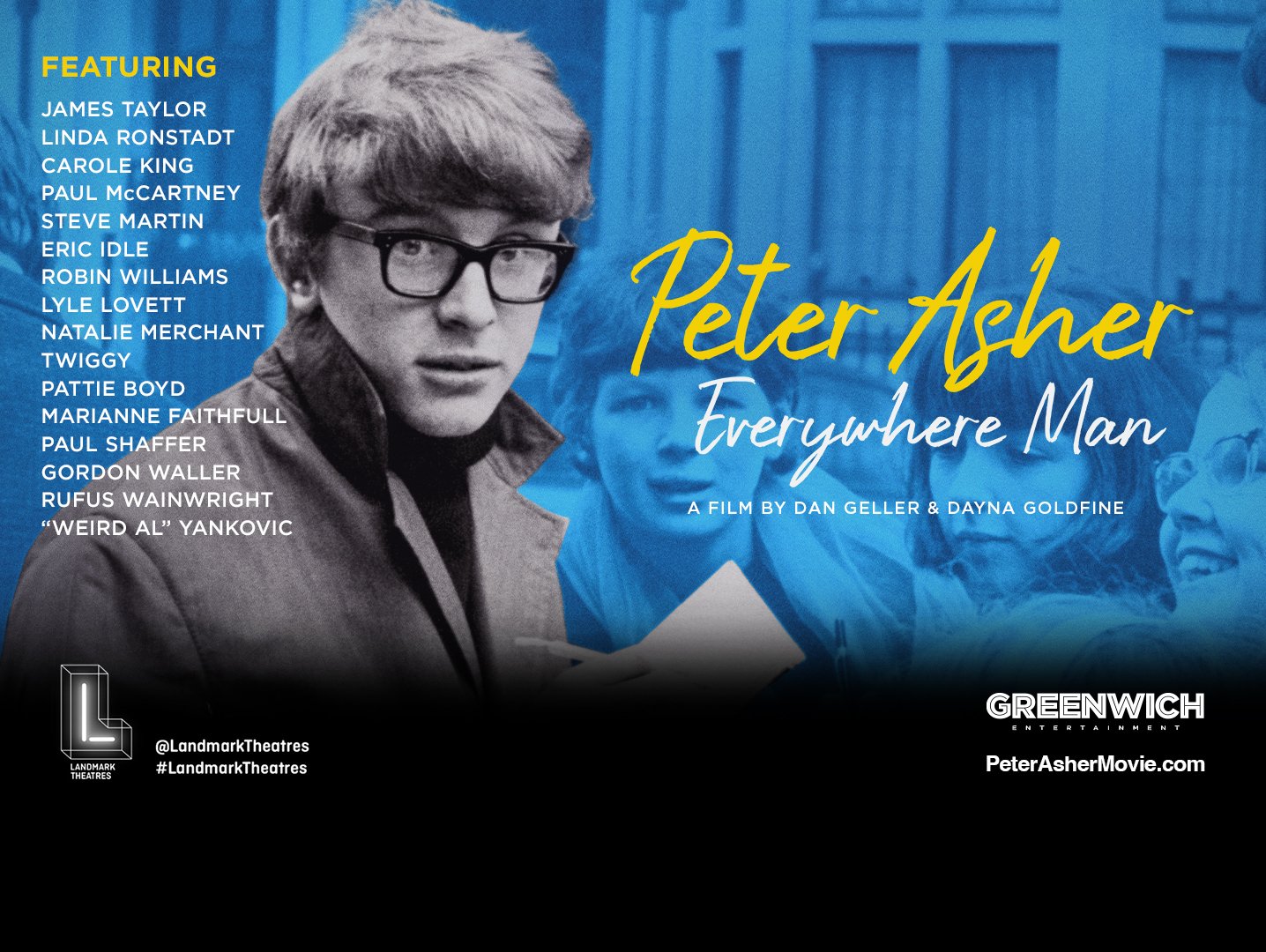
His story is magnificently told in Peter Asher: Everywhere Man, directed by Dan Geller and Dayna Goldfine, the Bay Area-based husband-and-wife team whose acclaimed backlist includes Hallelujah! Leonard Cohen, A Journey, A Song, and many more outré features, including Ballets Russes and Isadora Duncan: Movement from the Soul. At two minutes short of two hours, it’s riveting throughout, filling in the pointillist detail of the early days we all thought we knew so well and telling us a whole lot more about his life as a catalytic figure in the music scene of the 1970s and ‘80s without whom there might be no James Taylor or Linda Ronstadt, and Carole King may never have walked on stage.
Like many creative projects, it owes to chance. A friend called Goldfine to say she had a spare ticket to Asher’s one-man show, A Musical Memoir of the ‘60s and Beyond. She knew nothing about Asher but accepted the invitation because she wanted to meet Ronstadt, who was her friend’s other guest. “Within ten minutes I could imagine a documentary about him.” It turned out someone else was working on one, but years down the line Ronstadt told Goldfine the deal had fallen through. Asher, who has never lost his English reserve (or, despite his fancy get-up, his nerdy looks), was at first reluctant. Happily, he was persuaded, and so too were his sisters Clare and Jane. And it was Jane, of course, who was the link to “the boys”.

Jane has never talked about her relationship with Paul McCartney, and she’s not about to do so now, in large part out of respect for her husband, cartoonist and illustrator Gerald Scarfe. But the siblings chatted around the kitchen table about their young lives as child stars, three distinct redheads – known as “the carrots of Wimpole Street” –officially listed and photographed together as a package deal under “Progressive Management” in the Spotlight directory. Peter and Jane appeared together as on-screen siblings in The Adventures of Robin Hood. Their mother, Margaret, was a professor of oboe at the Guildhall, where a young man named George Martin attended for some brush-up lessons. Their father, Richard, was an eminent physician who identified and named Munchausen’s Syndrome and whose thought-provoking medical writing might today have made him a media personality.
Jane was something of a star, a young English rose, by the time the Beatles hit. She was already a regular panellist on Juke Box Jury and, as a young tastemaker, she was despatched by the Radio Times to the Royal Albert Hall to interview the band. All of them fell for her but, having only seen her in black-and-white on television, were surprised to encounter a redhead. Paul won her heart, and he was soon a regular at the Asher dinner table, finding at 57 Wimpole Street the family life he’d missed since his mother died but also an atmosphere of intellectual stimulation and relentless activity. When fame overwhelmed The Beatles and hotels became impossible, Margaret suggested he move into their spare attic room – which even had a piano.
Peter, meanwhile, who had found coffeehouse success with his Westminster School pal Gordon, was reading philosophy at King’s College, London. The duo were spotted by EMI’s Norman Newell at the Pickwick Club on Great Newport Street, something of a celebrity hot-spot owned by Harry Secombe, singer, and a member of The Goons, who were famously recorded by George Martin – a fact which endeared him to John Lennon in particular. They needed a song, and Asher remembered a number McCartney had played him which the Beatles had rejected. It just needed a bridge, which was scrambled together at the last minute before Peter and Gordon, like John, Paul, George, and Ringo before them, headed to Abbey Road. And at that moment Asher decided he wanted to be a producer.
But that would have to wait. Peter and Gordon would disband in 1968, by which time Asher was a key figure in what had become the counterculture. While Carnaby Street and the King’s Road defined “the scene” that was mainstream Swinging London, the Indica Bookshop and Gallery was the hub for the intellectual avant-garde. Located first in Mayfair, and later on Southampton Row, the store was owned by Asher’s friend John Dunbar and Barry Miles, an art student-turned-bookseller whose friendship with Allen Ginsberg and Lawrence Ferlinghetti would lead him to organise the celebrated International Poetry Incarnation at the Royal Albert Hall in 1965. Asher – who had been best man at Dunbar’s wedding to Marianne Faithfull – was a silent partner. McCartey helped build bookshelves while the stock they would hold was stored at Wimpole Street, serving to broaden Paul’s reading. In Indica’s basement was born International Times, and in its Gallery, John Lennon first encountered Yoko Ono. The interviews and archival footage amassed for the film are fascinating, Miles impishly admitting from beneath his still-luxuriant bouffant that Indica was named in honour of cannabis indica. Inevitably, financial troubles led to its closure in November 1967. (Miles packed up the archives and deposited them in the basement library of the Tate, where they were preserved as a time capsule of the Swinging Sixties.)
Next stop for Asher was as head of A&R at The Beatles’ utopian Apple label. As had been promised, he listened to every tape that arrived on his desk, finding one with real potential: it was by James Taylor, despatched to him at the suggestion of Danny Kortchmar, who had played guitar in a pick-up band for Peter and Gordon on their American tours. Asher loved it, and so did McCartney: James Taylor was released in December 1968. Sales were poor, in part due to the chaos at Apple but also perhaps because newbie producer Asher, with McCartney’s help, had over-produced it.
Taylor, who was battling his own demons, headed back to the States, followed by Asher, so convinced of the young man’s potential that he quit his job at Apple and headed to Southern California. Neither of them had any money, so the album that would become Sweet Baby James was essentially developed in Peter’s living room, which had a grand piano but little else. Taylor was keen to have Carole King play piano and Asher, who’d long admired her songwriting, worked hard to persuade her to come out of the shadows. Thus were two careers launched, and, of course, one of music’s celebrated partnerships.

It all took off from there. Asher, like George Martin, had great ears – but little ego, so he was always willing to listen to his artists, never imposing his ideas. Linda Ronstadt was recognised as a vocal powerhouse, but her career was stalling as managers and producers tried to mould her into a cookie-cutter pop-country act. Asher trusted her musical instincts but reined in the chaos of her open-door recording sessions, created the sonic architecture through which her voice could shine and brought in top-notch musicians. Heart Like a Wheel hit number one and launched a 15-year partnership. California’s soft-rock sound owes much to his work.
Over his legendary career, Asher has produced 37 gold and 22 platinum albums in the US alone, twice winning the Grammy Award for Producer of the Year, with artists as diverse as Diana Ross, 10,000 Maniacs, Rodrigo y Gabriela, and Robin Williams, as well as working with Hans Zimmer on several soundtracks. He also dipped back into his old life, playing Beatlefests with Gordon Waller (who died in 2009), and for a time was Vice-President of Sony Music Entertainment.
Everywhere Man is an appropriate title, a play, of course, on another song by his old friends Lennon and McCartney. It’s a terrific film, telling a slice of largely unknown, or at least underappreciated, music history. Go see it.
Related