

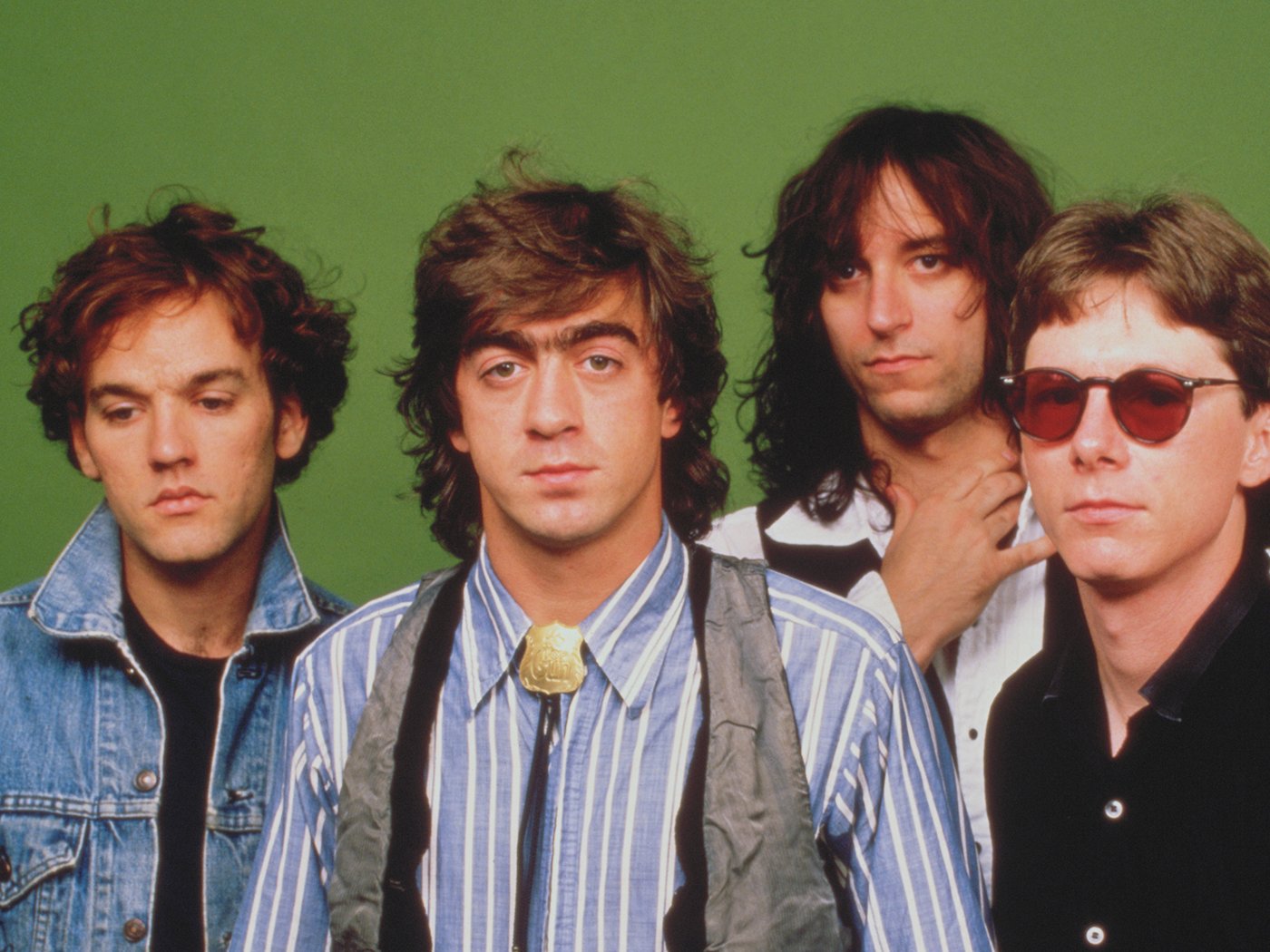
Before they’d even chosen a band name, Bill Berry, Peter Buck, Mike Mills, and Michael Stipe played their first show together in April 1980.The event was a mutual friend’s birthday, and the venue was St. Mary’s Episcopal church, one of the oldest structures in Athens, Georgia, and popular place for squatters. “Scared shitless” to be in front of even a small audience, they plowed through a set heavy on covers, including The Sex Pistols’ “God Save The Queen” and Jonathan Richman’s “Roadrunner”. It was an inauspicious debut, and they followed it 10 days later with a bigger gig at a local club for roughly 150 people. By then they werecalling themselvesR.E.M.
The quartet spent the next ten years gradually transforming themselves into one of the biggest bands in the world, with a massive international following and a remarkable run of innovative rock albums to their name. Even when they notched their first radio hit—“The One I Love”, from 1987—they seemed like the most unlikely rockstars imaginable, counterprogramming to the glut ofspandexedhair-metal acts of the 1980s and even the grunge bands of the early 1990s.They projectedintegrity and intra-band egalitarianismby touring on their own schedule, turning down lucrative deals, and famously dividingsongwriting royalties equally among the four of them.They nurtured acts like Indigo Girls, Wilco, and Grant Lee Buffalo at critical points in their careers, and made a point to shout out their influences, including Big Star and Pylon.Kurt Cobaineven cited R.E.M. as a model for how a band should operate.
In the early 1980s, however, they were merely one ofmany bands slogging it out in the American underground scene, touring heavily in small, dingy clubsand cobbling together funds to record.What set R.E.M. apart from their peers, however, was their air of mystery. They didn’t appear on their album covers—a rarity evenamong indie bands. Theydidn’t print their lyrics in the album inserts,and Stipe sang in a curious mumble, usually pitched low in the mix. You had to lean in to hear him, but that didn’t mean you understood exactly what he was singing about. Stipe rejected confessional lyrics in favor of impressionistic imagery, southern adages, and dream logic:“Weankledup the garbage sound, but they were busy in the rows,” hesingson “GardeningAtNight”, from their 1982 debut EP,Chronic Town. Or, from “Radio Free Europe”: “Keep me out of country in the word, deal the porch is leading us absurd.”Stipewrote songs like puzzles, demanding attention and imagination from the listener, and Berry, Buck, and Mills made sure you could dance to the conundrum.
Whentheystarted touring, they didn’t stop until the 1980s were over.R.E.M.played hundreds of shows a year, honing their sound as they built up a grassroots fanbase around the country. In 1984 they released their first album, recorded in North Carolina with Don Dixon producing, and their inventive mix of gangly postpunk and jangly 60s rock madeMurmurone of the great debuts of all time. After that, they released an album every year until 1988’sGreen, their major label debut. It’s a remarkable run, eachrecordwith its own personality, its own variation on the R.E.M. sound. One of those albums—1987’sDocument—evenincluded an actual hit.Featuring one of Buck’s finest guitar riffs and sharp background vocals from bassist Mills,“The One I Love” sounded especially cryptic on the radio, as Stipe shouted “fire!” inbetween Bon Jovi and The Bangles. Maybe it was a love song (“this one goes out to the one I love”) or maybe it was about groupies (“a simple prop to occupy my time”), but it landed in the US top ten and securedthema deal with Warner Brothers Records.
Remarkably, even as they graduated to a major label, R.E.M. took nothing for granted. They kept adjusting their sound and playing around with their roles in the band. Who said Peter Buck always had to play electric guitar? Why should Mike Mills be restricted to bass? Buck set aside his trustyRickenbacker and picked up a mandolin, which was he still mastering when they began writing songs for 1991’sOutOfTime.Sohe didn’t play the instrument in a country or bluegrass style; instead, he strummed it the way he would strum his guitar, which added a dreamy quality to “Losing My Religion”. It was an unlikely choice for a lead single, not only for the mandolin but also because it had no chorus, but the song became a massive global hit in the months before grungehitand the underground overtook the mainstream.
If R.E.M. had spent the ‘80s refining their sound, they spent the next decade tearing it apart and reassembling it in all new ways.Automatic ForThePeople, from 1992, was both somber and playful as Stipe wrote some of his most direct and personal lyrics about livingin the country (“The Sidewinder Sleeps Tonight”) and the death of his parents (“Sweetness Follows”). Meanwhile, the band experimented with loops and strings (courtesy of Led Zeppelin’s John Paul Jones). They did not tour for thealbum, butwrote 1994’sMonsterspecifically to take out on the road. It’s a glam-rock stomper that emphasizes Buck’s guitar heroics and finds Stipe teasing revelations about his own sexuality. Even as other alternative acts fretted about their newfound success, R.E.M. were curious about their own celebrity, both the confusion it engendered and the possibilities itopened up. As they graduated to bigger venues, they were comfortable on any stage with any crowd.
R.E.M. had modeled egalitarianism for so long that the loss of one member surely signaled the end of the band. During a 1996 show in Lausanne, Switzerland, drummer Bill Berry suffered a brain aneurysm and was rushed to the hospital. He made a fullrecovery, butleft the group and retried to his farm back in Georgia. The remaining members decided to soldier on as a trio.Up, released in 1998, remains their most experimental album, revealing a band casting about for new sounds and new directions: ambient, pop, glam, even Beach Boyish orchestrations. Rather than desperation, they celebrate these various possibilities, turning what could have been an end into a new beginning.
R.E.M. knew right when to hang it up. Following 2008’s heavierAccelerateand 2011’s more reflectiveCollapseIntoNow, the trio announced they were breaking up. They went their separateways, butstill made music: Stipe is working on a solo album, Buck has recorded frequently with number of collaborators (including members of Sleater-Kinney), Mills has toured extensively with the Big Star Band, and even Berry came out of retirement to play in the Athens supergroup The Bad Ends. Rather than reunite, they’ve let a new generation take the reins, specifically the touring tribute band led by actorMichael Shannon and indie-rock veteran Jason Narducy.Watching that band play their songs was a “very meta and very wild” experience for the members of R.E.M., who relished hearing the music from a new place: “It’s such an incrediblehonourfor the four of us to be able to experience that in a room as an audience member.”