

Open a streaming service, type in the word “focus” and you enter music’s parallel economy: a vast, largely faceless world of playlists with names like Peaceful Piano, Ambient Study, Brain Food, Music For Reading or Coding Mode, each followed by hundreds of thousands of people who are not exactly listening, but not exactly ignoring either. The tracks share a grammar of unobtrusiveness: downtempo instrumentals, no abrupt chord changes, muted drums, limited dynamic range and just enough rhythmic movement to stop the mind floating away altogether.
It has acquired the name “focus music”, but the one thing it is designed to do is ensure that you don’t actually focus on the music. Instead, it is intended to block distractions, calm you down and improve productive flow. This is music engineered for the 21st-century world of the work-from-home office and the easily distracted online student.
But focus music has a much longer and more peculiar genealogy. Its history runs through avant-garde Paris, American factories, German synthesiser laboratories, New Age wellness culture and Brian Eno’s ambient experiments before ending up in today’s streaming playlists. What seems like a thoroughly modern phenomenon is actually the latest chapter in a century-old argument about what music is for.
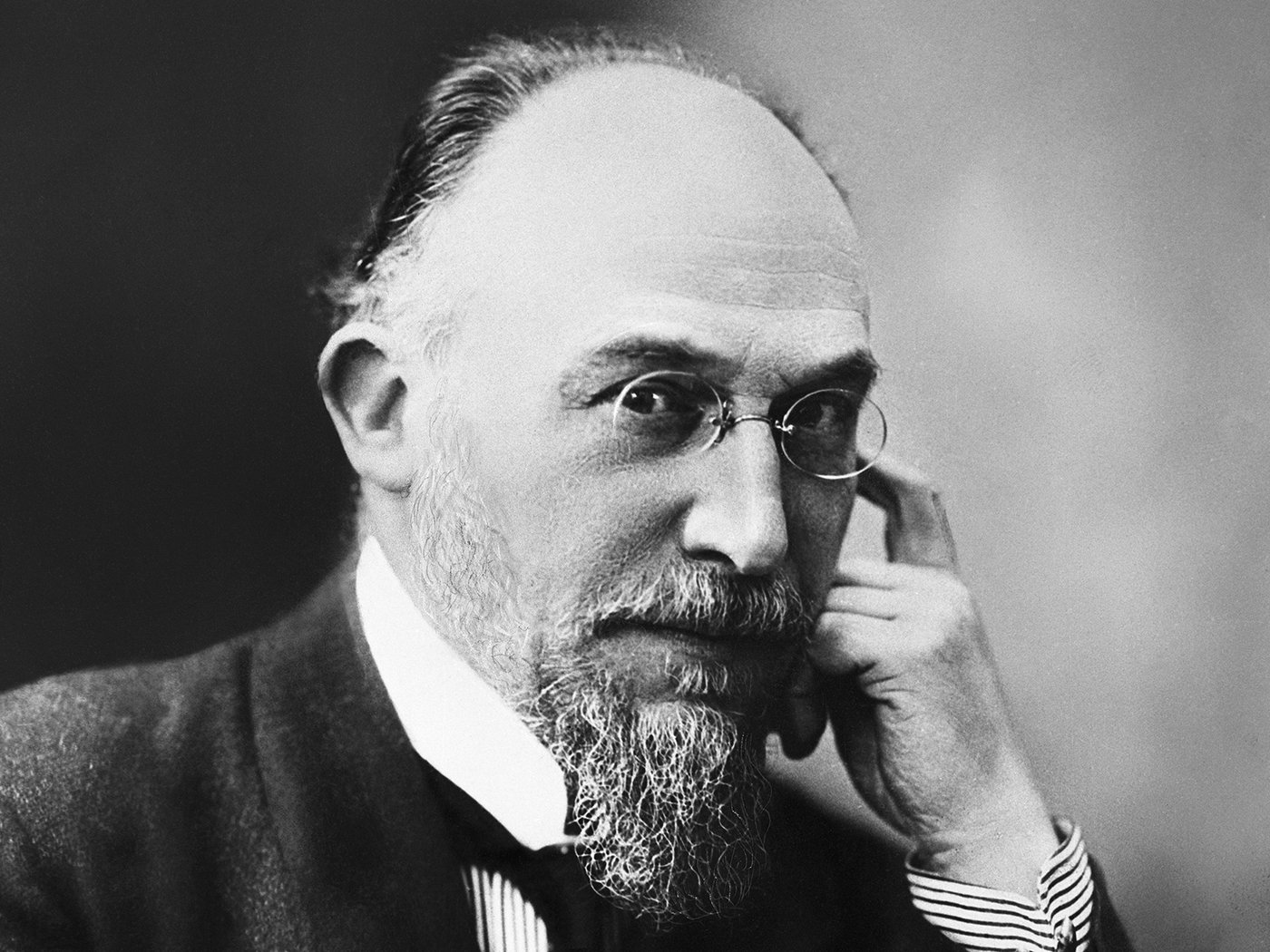
The story begins with Erik Satie.
Some time around 1917, the French composer developed what he called “furniture music”. Music, Satie proposed, could function as sonic wallpaper. To this end he wrote a series of pieces that were short, quirky, unchallenging and intended to be repeated. Their titles specified social uses: music for the arrival of guests, for a bistro, for a civil marriage. Famously, when he premiered this music at the Galerie Barbazanges in Paris in 1920, the attendees sat attentively, as one might at any concert. An infuriated Satie wandered among the seated audience.
“Talk, for heaven’s sake!” he shouted. “Move around! Don’t listen!”
This comic scenario addressed a serious idea. Western concert culture, located in darkened auditoriums, had turned musical listening into a solemn ritual, demanding our rapt attention. Conversely, Satie was suggesting that music might not be the main event. It could mingle with conversation, movement and the clatter of plates.
It wasn’t long before this concept acquired an industrial form in the United States. In the 1920s, a company called Wired Radio Inc began distributing calming music to a private network of paying customers in New York through high-frequency wired systems. By 1934, the firm had renamed itself Muzak (a deliberate echo of the film company Kodak, fused with the word music). This trade name became identified with a kind of functional background music, intended not just to entertain workers and shoppers, but to serve as a form of behavioural control. Muzak was organised into 15-minute sequences that started just below the average heart rate of 72 beats per minute and gradually increased in tempo and intensity, followed by periods of silence.
In factories and offices, the theory went, this process of “stimulus progression” could counter fatigue, maintain morale and raise productivity. It soon swept across the US, being piped into factories, airports, railway stations, doctors surgeries and government buildings. In 1948, when the Otis Elevator Company realised that many people were scared of entering confined and unfamiliar spaces, it started piping Muzak into its lifts to calm and reassure punters, hence the term “elevator music”.
Muzak eventually became a synonym for sanitised blandness: this was music that avoided any distractions: songs were stripped of prominent vocals, strong dynamic contrasts and other elements likely to grab your attention. The point was that it had to be noticeable enough to change behaviour but not interesting enough to distract you from your work.
A more artistically exalted strand of the story emerged in the 1960s through minimalism. Terry Riley’s In C, first performed in San Francisco in 1964, consisted of 53 short musical figures that performers repeated and moved through at their own pace. Steve Reich, who took part in the first performance, suggested the steady high-C pulse that helped hold the work together. The result could continue for an indeterminate duration, generating complex patterns from simple repeated materials.
Reich developed repetition differently, using tape loops and instrumental patterns that gradually moved out of alignment. Philip Glass built music from arpeggios, additive structures and slowly transforming cells. These composers were not producing aids to office work. Their repetitions demanded discipline from performers and could be disorientating for listeners. Yet minimalism established much of the musical vocabulary later absorbed by focus playlists: stable pulse, tonal harmony, extended duration, repetition with incremental change.
In Germany, Klaus Schulze brought a related principle into electronic music. A former drummer with Tangerine Dream and Ash Ra Tempel, he began releasing solo albums in the early 1970s built from organ, tape, synthesisers and, increasingly, sequencers. A pulse would begin, a chord would hover above it, filters would open and close, and the apparent landscape would change with almost geological slowness.
A few years later in Britain, Brian Eno made the link between avant-garde ambient sound and functional listening explicit. In the sleeve notes to Ambient 1: Music for Airports in 1978, he acknowledged Muzak as a pioneer of music designed to function as environmental background, but rejected its attempt to eliminate uncertainty and interest. Ambient music, he argued, should create calm and “a space to think”, while remaining capable of accommodating different degrees of attention. It should be ignorable and interesting at the same time.
Other musicians brought ambient sound closer to ideas of “wellness” and healing. In 1979, prog rock guitarist Steve Hillage and his synth-playing partner Miquette Giraudy made Rainbow Dome Musick for the Mind-Body-Spirit Festival at Olympia in London. Its two long pieces combined synthesiser sequences, electric piano, bells and Hillage’s gliding guitar into a benevolent, enveloping drift. Across the Atlantic, a music graduate called Edward Larry Gordon renamed himself Laraaji and developed a luminous style using amplified zither, hammered dulcimer, gongs, voice and improvisation, informed by yoga, meditation and spiritual practice. Meanwhile, in the heart of Silicon Valley, in Palo Alto, California, a guitarist called William Ackerman founded Windham Hill, a record label that turned instrumental calm into one of the defining lifestyle sounds of the 1980s. It specialised in pristine recordings of acoustic guitar, piano and chamber-like ensembles: marketed as a tasteful refuge from urban noise and rock bombast.
By the 21st century, functional listening had split into several overlapping traditions. Muzak sought productivity. Minimalism sought perceptual intensity. Ambient music sought environmental transformation. New Age music sought healing and serenity. Chill out music offered refuge for exhausted acid house casualties driving home from raves. There were also plenty of dreamy, hypnotic excerpts from film soundtracks – by the likes of Ry Cooder, Hans Zimmer, Max Richter and Jóhann Jóhannsson – to draw from.
Digital streaming gathered all these traditions together and renamed them according to tasks. Instead of being asked which artist or genre they want to hear, those wanting “focus music” might instead be asked what they are doing: waking up, commuting, cooking, exercising, sleeping, meditating, studying. Spotify’s Deep Focus is explicitly described as music for concentration during work, study or relaxation. BBC Radio 3 Unwind offers “Piano Focus”, meditation programming and long stretches of calming classical music designed to support listeners through the day. The music is classified by the promised outcome.
This has encouraged a new set of musical conventions: no vocals; slow or moderate tempos; predictable rhythms; few startling transitions; long playlists in which one track dissolves almost invisibly into the next. The music gives the impression of being weightless and frictionless, using synthesized drones, hints of soft hip hop beats, vinyl crackle and fragments of smooth jazz, along with muted piano and subdued strings.
Whether it actually aids concentration is debatable. A systematic review covering 95 studies and 154 experiments struggled to find any link between background music and cognitive performance. There is some evidence that listening to your favourite music can improve mood, while certain kinds of instrumental music may reduce mind-wandering for some people. But, for deep reading, writing or complex comprehension, silence frequently outperforms music.
Maybe focus music works through ritual. Putting on the same playlist announces that work is beginning. Headphones create a boundary against the surrounding world, particularly in an open-plan office. The music does not necessarily make the brain more intelligent; it makes the working environment feel more controllable. That was Satie’s unlikely bequest. Music could become part of the room, but the room would no longer feel quite the same.