

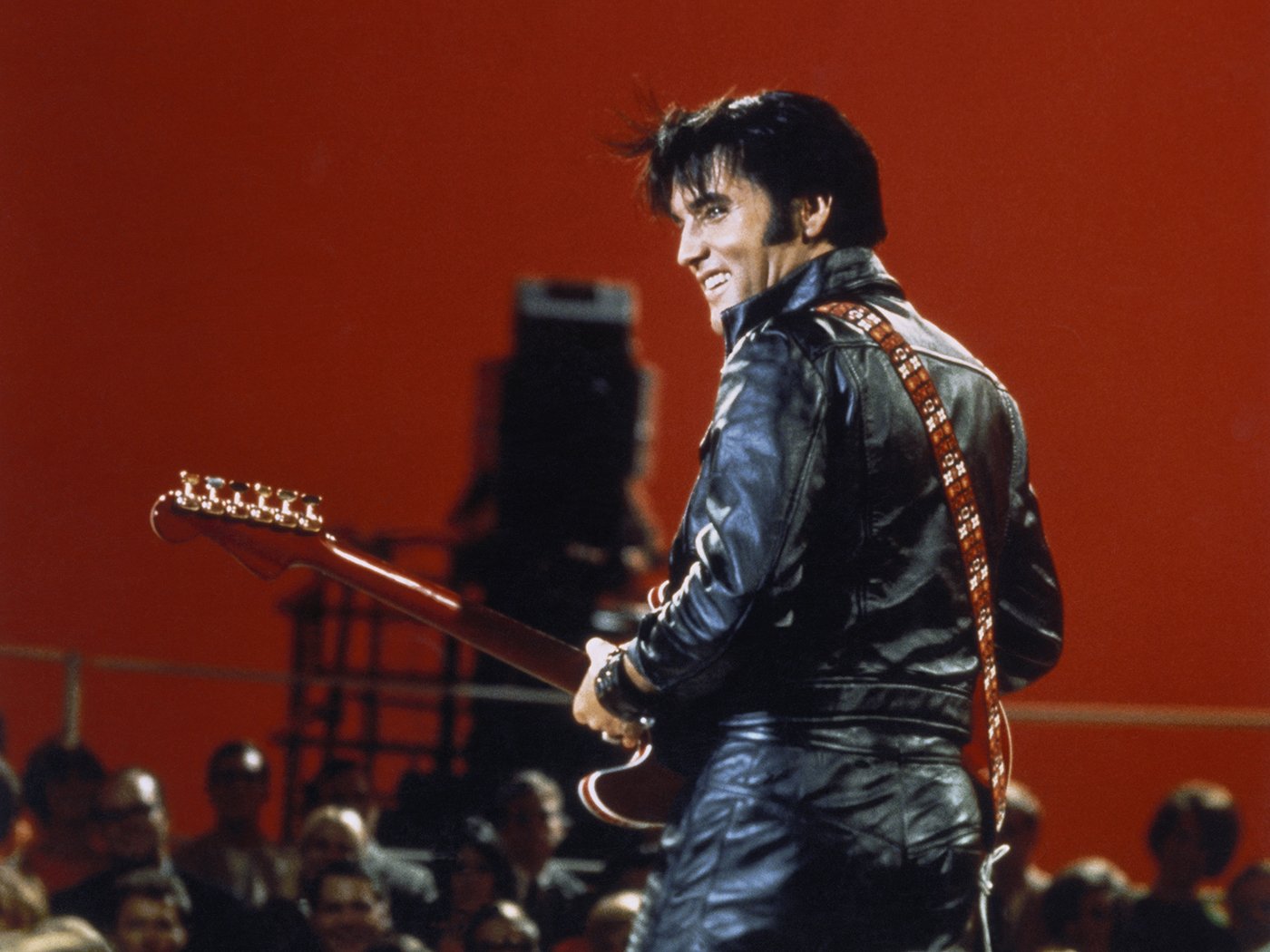
During his 17 months on Sun Records, Elvis Presley changed himself and the whole world utterly. He entered the studio in 1954 as a withdrawn teenager with blonde hair, pimples, and an almost debilitating shyness. When he signed with RCA in 1956, he was a seasoned live act renowned for his energetic performances and a recording artist who confidently blurred the lines between country and r&b. His skin had cleared up, he started dying his hair jet-black, and he talked a lot more.
Throughout the next 20 years — until his death in 1977 — Elvis never stopped changing and never stopped changing the world. Every aspect of his career was brand new: no one had ever been that famous before, especially a hip-shaking bumpkin from Tupelo, Mississippi. He had no one else on which to model his behavior or his career, so every step he took, whether it was joining the Army or making a movie, was like stepping off a cliff. He set the template against which all rock stars—and pretty all celebrities full stop — modelled themselves.
Elvis is so famous even today, nearly 50 years after his death, that it’s easy to underestimate the impact he had on global pop culture. So here are just ten of the many ways Elvis changed the world.
1. He was the first major crossover artist.
Most of Elvis’ Sun singles had a country song on one side and an r&b song on the other, which opened two very different markets for the young artist. At first his sound was too white for Black radio stations and too Black for white stations, but as his music became popular, he broke in nearly every market, including gospel. Seventy years later, artists like Taylor Swift and Beyonce are still using that cross-genre strategy.
2. He changed how rock stars dress.
Onstage, Elvis rejected the denim-and-t-shirt uniform preferred by rockabilly artists, and he rarely sported a suite and tie onstage. For most of his life he shopped at Lansky Brothers on Beale Street, favoring flashy jackets with names like “Date Bait” and “Super Cool”. His ‘70s jumpsuits, with their flared pantlegs and wide collars, became iconic, and a pair of thick gold sunglasses practically screams ELVIS.
3. He changed how rock stars performed.
At one of his very first shows, Elvis was reportedly so nervous that his leg started shaking. When fans picked up on it, he exaggerated the movement, swiveling his hips and thrusting toward the stage. Adults saw it as a moral threat to society, but kids went wild. Even during his late ‘60s Tigerman phase and his overmedicated era in the ‘70s, he was always a kinetic and physical performer, prowling the stage and even doing the occasional karate kick. Every rocker since then has aped at least one of those moves.
4. He helped make teenagers a powerful demographic.
Adults barely knew what to do with this kid out of Memphis, but his young fans funneled their allowance dollars toward singles, tickets, albums, magazines, and anything else with his name on it. They exercised their postwar spending power to make him an icon. Previous stars had appealed to teenagers — including Benny Goodman and Frank Sinatra — but Elvis helped establish that adolescent demographic as the driving force in pop music. The kids wouldn’t have screamed for The Beatles if they hadn’t already been yelling for Elvis.
5. He was the first rock star to embarrass himself… on a massive scale.
Mighty calamities befell that first generation of rock stars: Jerry Lee married his young cousin, Little Richard found God, Buddy Holly was killed in a plane crash. But no fate was quite as humiliating as Elvi’s decadelong stretch in Hollywood, during which he made more than 30 bubblegum flicks ranging from kinda fun (Viva Las Vegas, Blue Hawaii) to absolutely excruciating (Kissin’ Cousins, The Trouble With Girls). Elvis was sidelined with slop while The Beatles and The Rolling Stones founded new variations on blues and rock. How bad was his Hollywood era? In 1982 a handful of his soundtrack tunes were compiled on a bootleg called Elvis’ Greatest Shit.
6. He invented the comeback.
In December 1968 NBC aired an hourlong special simply titled Elvis, which mixed elaborate stage productions with raw live performances. Its success rescued him from motion-picture purgatory and re-established him as a vital artist. Big tours and bigger hits (including “Suspicious Minds” and “Burning Love”) quickly followed. Now known as the ’68 Comeback, that special did something unprecdented: By reintroducing an older performer as something more than a nostalgia act, it proved that anyone could have a second act.
7. He popularized the Vegas residency.
In 1969 Elvis accepted a residency at the International Hotel in Las Vegas, which amounted to more than 600 sold-out performances over a seven-year period. Many performers had set up shop in Sin City — the Rat Pack were already well established — but Elvis’ run became legendary for its lavish production and his updates on old hits. He redefined the Vegas residency as a victory lap, and artists as diverse as Bobbie Gentry, Garth Brooks, Celine Dion and Lady Gaga have followed suit.
8. He popularized the live show as a global event.
In 1973 Elvis played a sold-out show at the Honolulu International Center, which was broadcast all over Asia and (with a slight delay) Europe using then-new satellite technology. While the concert didn’t air in the States for three months, it was seen by an estimated 1.5 billion people in 36 countries, making it the biggest television event ever. The accompanying live album, Aloha From Hawaii Via Satellite, quickly debuted at the top of the album charts. Ambitious and costly, it helped create a market for global multimedia events like Live Aid and The Eras Tour.
9. He was the first major artist who was more profitable dead than alive.
Elvis’s death made him a lucrative property — and not just for his estate. His albums continued to sell well, and Graceland opened as a popular tourist destination in 1982. Beyond that, he became the subject of salacious tell-alls, sanitized biopics, tabloid headlines, and more than a few unflattering punk songs (such as Mojo Nixon’s “Elvis Is Everywhere” and Charlie Burton’s “Breathe For Me Presley”). Extremely popular in life, he became legendary in death.
10. He became a ghost story, a conspiracy theory, and a punchline.
There’s an old campfire story about a truck driver who picks up Elvis hitchhiking outside of Memphis and deposits him at the gates of Graceland. He then turns on the radio to hear that Elvis has died. Sightings of Presley in both corporeal and ghostly form were as popular in the 1980s as alien abduction, and nearly as believable. Some fans spotted him at various Stuckeys around the South, while others insisted he had retreated to a private island with JFK and Marilyn Monroe. In death, Elvis got downright weird, but he also did something few other human beings have accomplished: he passed over into folklore.