

This article originally appeared in Uncut’s June 2010 issue
You’re early. Of course you’re early. If you’re any kind of fan of country music – if you’ve any passing regard for American popular song at all – you’re not going to risk showing up late for this one. You stand briefly outside the designated rendezvous, a diner – or, as its signage has it, “Eating & Drinking Establishment” – called Lulu’s. You consider killing twenty minutes with an unguided walking tour of Redding, the burg in which you find yourself, but are dissuaded by fear of getting lost and, more tangibly, by weather which is freezingly and soakingly contradicting every stereotype of spring in Northern California.
You tramp, dripping, into Lulu’s and collect from racks just inside the door the reading material on offer: the local what’s-on paper – a slender publication – and a red, white and blue pamphlet endorsing one Colonel Pete Stiglich (“Traditional conservative Republican”) for Congress. You tell the waitress who you’ve come to meet, and you’re directed to what is apparently the preferred corner booth. You adjust yourself on the blood-coloured upholstery for the best view of the rain-lashed car park; you want to see him coming.
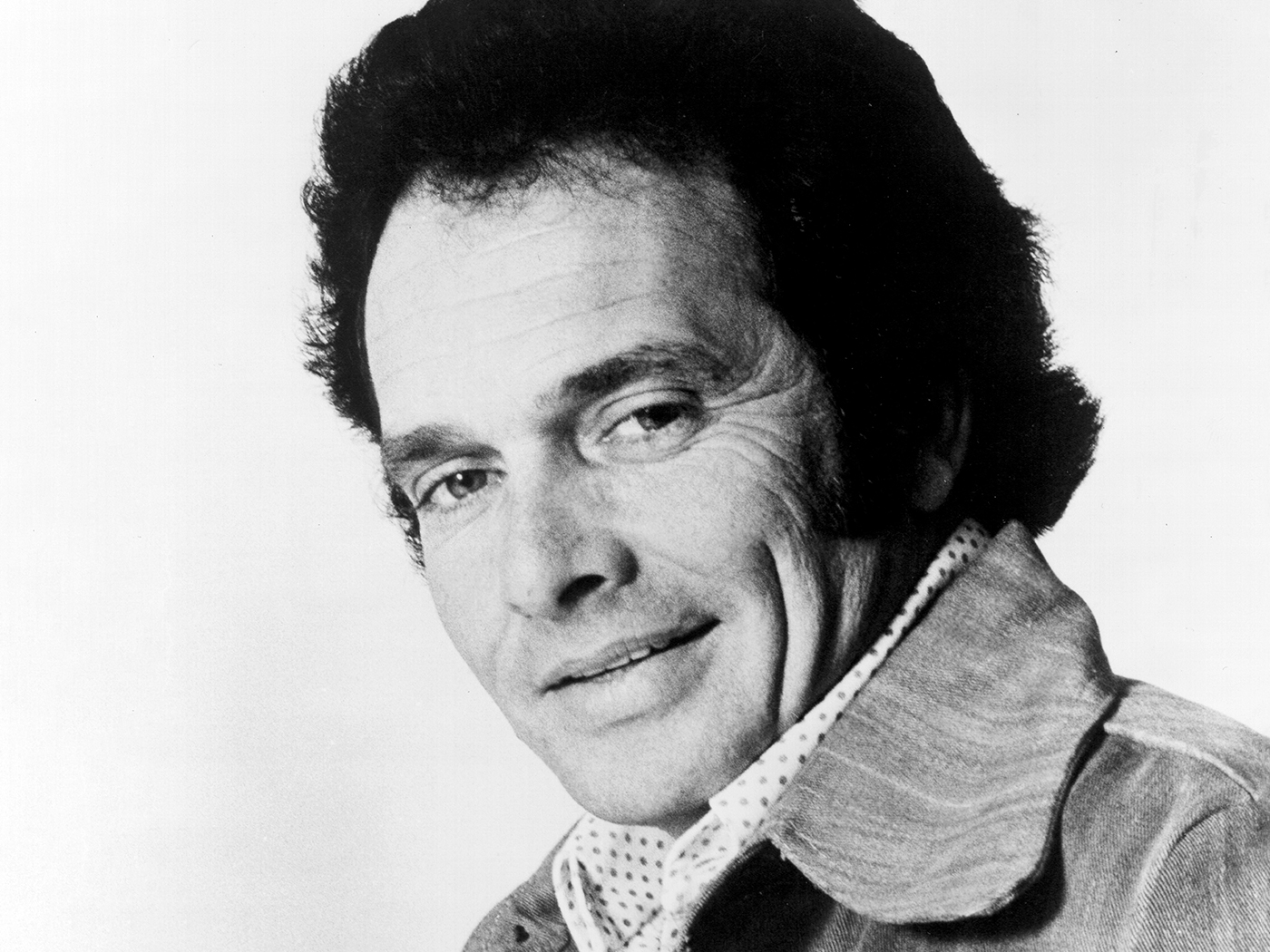
On the stroke of 11, the other vehicles in the lot, impressively hefty though many of them are, are dwarfed by a gunmetal grey Hummer. From it emerges a gnarled, gnomish, silver-bearded figure. From the ground up, he wears tan ostrich-skin boots, blue jeans, a threadbare grey Harley-Davidson t-shirt, a shapeless black coat and a khaki bush hat that looks like it might recently have been retrieved from the jaws of a playful dog. You lose sight of him as he walks around to the front door of Lulu’s, and so you throw back the last of your first coffee, stand, and prepare to offer your hand.
“Good morning,” he says, taking it and shaking it. “I’m Merle.”
Merle Haggard eats at Lulu’s a couple of times in an average week, he reckons. His (fifth) wife, Theresa, isn’t much of a breakfast eater, he explains, and so he makes the 20-minute drive here from the ranch outside town where he has lived since 1980. The staff know him, and so do some of the customers, but if there was ever any excitement here about regularly dining alongside a genuinely legendary figure, everyone is past it: people say hi, he says hi back. He orders two eggs over medium, and a short stack of pancakes. In the background, a radio plays.
“I scan by the stations once in a while,” says Haggard. “But I don’t spend a lot of time listening. Never did, really. I still pretty much enjoy the same music that I’ve always enjoyed. Keeping up with my own productions really doesn’t leave me much time to explore what’s going on. The cream of the crop you hear about. I know that Rascal Flatts are hot, and that little girl, uh…”
“I still pretty much enjoy the same music I’VE ALWAYS ENJOYED”
Taylor Swift? “Yeah, Taylor Swift. I know about those people, but I don’t spend a lot of time trying to figure out why.”
He laughs, not for the last time, a guttural, sputtering laugh that turns, not for the last time, into a cough (Haggard underwent surgery on a cancerous lung in November 2008). It must be strange, I suggest, listening to those radio stations and being Merle Haggard: you wouldn’t ever hear a song that you couldn’t hear yourself in.
“Yeah,” he smiles. “Either me, or somebody I was friends with.”
The seventy-odd albums Haggard has released since 1965 amount to one of the most astonishing and influential songbooks ever assembled by a single artist. Haggard seized the template bequeathed by his idols Bob Wills, Lefty Frizzell and Hank Williams – apparently simple songs which secreted considerable depth, songs which epitomised the specifically country knack of saying a great deal by saying very little – and breathed fresh vigour into it, layering it with the twanging Telecasters and breezy pop choruses with which Buck Owens and Wynn Stewart were, in the mid-1960s, re-orienting country’s centre of gravity from Nashville, Tennessee to Bakersfield, California (Owens’ ex-wife, Bonnie, would become the second Mrs Haggard). It’s a formula with which Haggard hasn’t since tinkered overmuch: no song on his terrific new album (I Am What I Am) would sound far from home on his first (1965’s Strangers).
“Somebody told me,” he says, “that once you have a reputation for making good records, then when you go into the studio you’re always just three minutes away from making a smash hit. And if you live your life that way, then you’ve always got a carrot out in front of you, and boredom will not be part of the picture.”
If the life story that has informed and inspired Haggard’s songs reads like a script for an indigestibly corny movie about a hopelessly cliched idea of a country singer, it’s because many of our cliched ideas of a country singer have been inspired by Haggard’s picturesque biography. Born, on April 6, 1937 in California to parents who’d moved from Oklahoma during the Great Depression, raised partially in a converted boxcar outside Bakersfield, devastated by the early death of his railroad worker father, prompted to an adolescence and early adulthood of misbehaviour and outright criminality, eventually redeemed by music, though not without subsequent mis-steps (difficulties with drink and drugs, one bankruptcy, four divorces, including one from the singer Leona Williams). In the annals of significant musical meetings, Robert Johnson’s deal with the Devil at a Mississippi crossroads is rivalled arguably in importance – and certainly in verifiability – by Haggard’s presence among the captive audience when Johnny Cash played San Quentin prison on New Year’s Day, 1959. The man and the myth are unusually closely related in Haggard’s case. Would his songs be so revered, you might wonder, if they’d been written by an abstemious accountant?
“You or I will probably never know about that,” he says. “That’s a great question, though. You ever get an answer, let me have it.” He smiles, his creased face suddenly illuminated by two racks of incongruous, impeccable white teeth.
“Take Job, in The Bible,” he ponders. “If the story of Job was taken away from him, what would he be worth? He had three thousand camels, he was a wealthy man. But the storyline, the devil tempting him and taking all his stuff away, and his re-rise to be even better than what he was before, that makes him more interesting. I like him. If I go to Heaven, I want to talk to Job. I want to know how he did that.”
There are parallels, granted: Job, like Haggard, had a second family relatively late in life. Haggard’s first marriage, to childhood sweetheart Leona Hobbs, produced four now-adult children (the eldest, Noel, is also a country singer). Today, Haggard and Theresa have a twenty-year-old daughter, Jenessa, and a teenage son, Ben – the latter has recently taken up guitar duties in Haggard’s long-serving band, The Strangers (“That’s ’cos he’s real good,” beams his father. “Anyone in my family has to be better than someone I can hire.”) There the similarities would appear to end: Job lived until he was 140, and still never made an album half as good as 1968’s Mama Tried.
“I think,” continues Haggard, “my trip to prison when I was younger was a definite help to my success in country music. Though I certainly didn’t do it on purpose.”
Haggard served three years in San Quentin for attempting to burgle a restaurant while drunk. He was paroled in 1960 – and formally pardoned by then-governor Ronald Reagan in 1972 – but returns to the penitentiary often on record. In the opening track of I Am What I Am, the wryly nostalgic “I’ve Seen It Go Away”, he remembers a country he has “Seen in its pride and all its glory/And I’ve seen it through the bars on a dark and stormy day.”
“Mmm-hmm,” he acknowledges, pursuing the pancakes around his plate with a fork. “And I hate to say this, but politically speaking, there was more freedom in San Quentin when I was there than there is in the streets of America now.” This seems a bit of a stretch.
“Everything you did this morning,” he insists, “has been recorded on film. That wasn’t the case in prison when I was there. They might as well put a wall up: they’ve got us all under surveillance. In jail at the time, you could play poker 24 hours a day if you wanted to. Now, you can’t even smoke. What a world we live in. You can’t smoke in a pool hall. What has happened?”
This question vexes Haggard throughout his new album, and throughout our conversation. Some of his political outlook is orthodox libertarianism – “People just want a cheque in the mailbox and they don’t want to do anything for it – what’s that about?” – and it must be conceded that Haggard is more entitled than most to a belief that people can work themselves out of unpromising circumstances. Some of it meanders into wilder, somewhat weirder territory – he perceives grim significance in the fact that many of the pharmaceuticals which Americans pop in absurd quantities are made in “…fuckin’ Germany. So who won the war?” Mostly, though, he just sounds disappointed. In the same song, he recalls Bob Wills and Elvis Presley, and notes that “When you’ve seen the very best, the rest can’t hardly play.”
“Those are just two that I picked out,” he says. “But I’m sure that they’re won’t be another Muhammad Ali in our time. And even though some people have hit more home runs than Babe Ruth, they still didn’t surpass the legend. Babe Ruth is still the greatest ball player who ever lived, when all the cards are in and all the chips are counted. Those kind of people are an example of what I’m trying to say there. I believe that we’ve seen the best on this planet. I don’t think we’ll ever get any better.”
“if you’re a student of life, you finally become a wise old bird”
Isn’t that just what getting older feels like for everyone? Perceiving everyone’s possibilities dwindling along with your own? “Maybe,” he allows. “I’m not real comfortable with it. But I suppose there are benefits to it. If you’re a student of life, you continue to learn, and you finally become a wise old bird, you know? I’ve accepted it, I guess, though not without a fight.”
It can’t make the process any easier when you are, yourself, often cited as evidence that they no longer make them like they used to. On George Jones’ 1985 hit “Who’s Gonna Fill Their Shoes?”, a heroically maudlin elegy to a disappearing creed, the second verse mourns (somewhat prematurely, in all three cases) the “Red-Headed Stranger”, the “Man In Black” and the “Okie From Muskogee”: Willie Nelson, Johnny Cash, Merle Haggard.
“I believe that’s right,” says Haggard. “I believe they’re as original as any diamond, or any fingerprint. They can only be imitated, they can’t be duplicated.”
At moments like this, the instinctive nature of Haggard’s easy facility with language becomes endearingly apparent: imitated/duplicated, the choruses just fall out of him. On cue, the radio plays Cash’s “A Boy Named Sue”. Haggard looks at once glum and wistful.
“Cash and I were real good friends,” he says, softly. “But that movie [Walk The Line] was terrible, I thought. I mean, maybe if you didn’t know him it was okay, but… I can remember Bob Dylan walking around Cash in a circle, looking him up and down and saying ‘You beat any goddamn thing I ever seen.’ And that’s Bob Dylan, the hippest motherfucker there’s ever been. Trying to take a guy [Joaquin Phoenix] that’s five foot five and make Johnny Cash outta him… that was funny to me.”
I wonder if that outlaw peer group were really as much of a gang as they portrayed themselves.“Aw, yeah,” he declares. “We’re still fans of each other’s work. If I can’t write something, I hope Willie [Nelson] or Kris [Kristofferson] can. I remember one time Willie was listening to a Kris Kristofferson record, and I walked in and I said to Willie, ‘I guess he’s about the best writer in the world, isn’t he?’ And Willie turned that sumbitch off, turned around and said ‘Yeah, after me and you.’”
The radio in Lulu’s moves onto “The Ballad Of The Green Berets”, the swaggering martial anthem made a Number One hit in 1966 by Staff Sergeant Barry Sadler. It’s only sort of a country song, but it’s still the sort of country song which causes many people to mistake the genre for a crock of flag-wavin’, God-fearin’ sentimental schlock freighted with a menacing undertow of xenophobic suggestion that you’re not from round here, are yuh? It’s an almost amusing irony that the one country song that has been most often used to uphold that simplistic prejudice was written by one of the form’s most subtle and astute composers. Merle Haggard and The Strangers are still touring, these days mostly playing in casinos and theme theatres. Are they still playing “Okie From Muskogee”?
“Yeah,” he says.
“Okie From Muskogee” was first a hit in 1969, in an America convulsed by the conflict between an insurgent anti-Vietnam war counter-culture and a conservative establishment. A warm, funny snapshot view of the world from the small hometown of Haggard’s father (“We don’t grow our hair all long and shaggy/Like the hippies up in San Francisco do”) it has been both embraced and dismissed as a statement of defiant redneck patriotism. Roy Rogers and George Jones, among many others, sang it straight – and Bruce Springsteen was surely alluding to it in “Long Walk Home”, when he invoked the flag flying augustly over the courthouse. Richard Nixon requested it when Johnny Cash played at his White House (Cash, clearly aware of the song’s manifold subtexts, refused, diplomatically if incredibly claiming not to know it). Oliver Stone deployed it in “Platoon” as the favourite singalong of the dim, drunk, good ol’ boy faction of his cinematic grunts. Splitting the difference, Bob Dylan has observed, correctly, that if “Okie…” had fallen from the pen of Randy Newman, it would be acclaimed as masterly satire.
“People,” says the song’s author today, “who’ve grown with some intelligence, like you and I have, find all kinds of different things to celebrate in it. I think the connection, between people, politicians, religions and all the rest of it, is pride. Everybody wants to be proud. I think that’s what it shares.”
The song, and its reputation, has followed Haggard around ever since (the same is true to a lesser extent of its follow-up, the more nakedly bellicose “The Fightin’ Side Of Me”, which suggested to America’s enemies within “If you don’t love it, leave it”). I wonder if Haggard ever feels the need to compensate for it – if indeed, that was what he was doing when, on the day after Barack Obama’s inauguration, he posted on his website (www.merlehaggard.com) a new lyric called “Hopes Are High”.
“I think most people,” he says, “even people who are against him… even Rush Limbaugh, if he told the truth, he’d have to say, I hope the god-dang guy succeeds. If you’re of a nature that wants people to fail, then I don’t give a fuck about you anyway. But if you want people to succeed, then I think for the most part people wish him their best. I was certainly in a positive way of thinking about him.”
It was an uncharacteristically upbeat song. “Country music,” he agrees, “is for the most part sad music.”
So the happy ones are tough to write. “The good ones are,” he says.
Either way, how do they work for him? It’s obvious by now that Haggard’s songs move and inspire millions, but do they serve as any sort of catharsis for the guy singing them? “Absolutely,” he says, with an emphatic plant of his coffee mug. “Yes, and I’ve never really talked about it. But it is a sort of therapy. And it actually works. It gets it all off your chest. You can shout about what you hate, and someone will listen. It’s kind of like throwing a tantrum or something.”
Is there a specific instance of that he can recall? “Yeah,” he says, almost as if surprised. “In the 60s, when we were fixing to record the live album of ‘Okie From Muskogee’, we wrote a song about Huntsville, the prison [‘Huntsville’, co-written with Red Simpson, which eventually appeared on 1971’s Someday We’ll Look Back]. And I remember having that feeling of release from the writing of that song, especially after we made a pretty good record of it. It didn’t get a lot of play, but it did that thing for me, that we were talking about.”
Asked about his health, Haggard taps the right side of his chest, as if hoping to produce an echo from the absence of the upper lobe of the lung, cut away 18 months previously.
“Considering who I am,” he says, “and what I’ve done, I’m about as good as could be expected. Two and a half months after the surgery, they took one X-ray and I haven’t been back, so I don’t know if the sumbitch has come back or not, but I’m 73, and I’m not going to go and get bad news. I’m gonna live with what I’ve got.”
Which he seems, on I Am What I Am, and in Lulu’s diner, serenely happy with. He clearly adores his wife (“She doesn’t give a shit whether I’m Merle Haggard or not. And she has made my last twenty years remarkable.”) He dotes on his kids. (“It’s the Christian belief that when you’re given a child late in life it’s a great blessing, and a compliment from God. My first family, I didn’t realise what a great chance I had. My second family, they’ve been my reason for being alive. I’ve limited time I’ve spent on music, so I can be with them.”) He’s resigned, affably grouchily, to the touring life (“The shows themselves are great, but the road business is not for everybody. I don’t know that I ever really enjoyed it.”). And he loves his ranch, to which he has to return (“There’s a whole bunch of family staying this weekend, else I’d invite you down – sorry about that.”)
Outside Lulu’s, surveying the weather, Haggard offers me a lift back to my hotel. From the wheel of the immense vehicle, he squints through the gathering storm, looking for the road ahead. “I’m a fortunate man,” he decides. “Every song I sing, the whole audience is singing it with me. That always raises the bumps on the back of my neck. Always. Nobody has to say anything else.”