
The enfant terrible
Shakespeare’s “seven ages of man” begins with “first the infant; Mewling and puking in the nurse’s arms”. Living up to this description, one of our first glimpses of Nick Cave comes from a video in which he wears nothing but a large nappy (or possibly a loin cloth) as he cavorts around like an overgrown baby, albeit one with “HELL” daubed across his chest. This was the deeply strange promo shot to accompany The Birthday Party’s cacophonous “Nick The Stripper”, and it brought a wild and unpredictable new musical force upon the world. When we’re young, eh?
The king of the goths
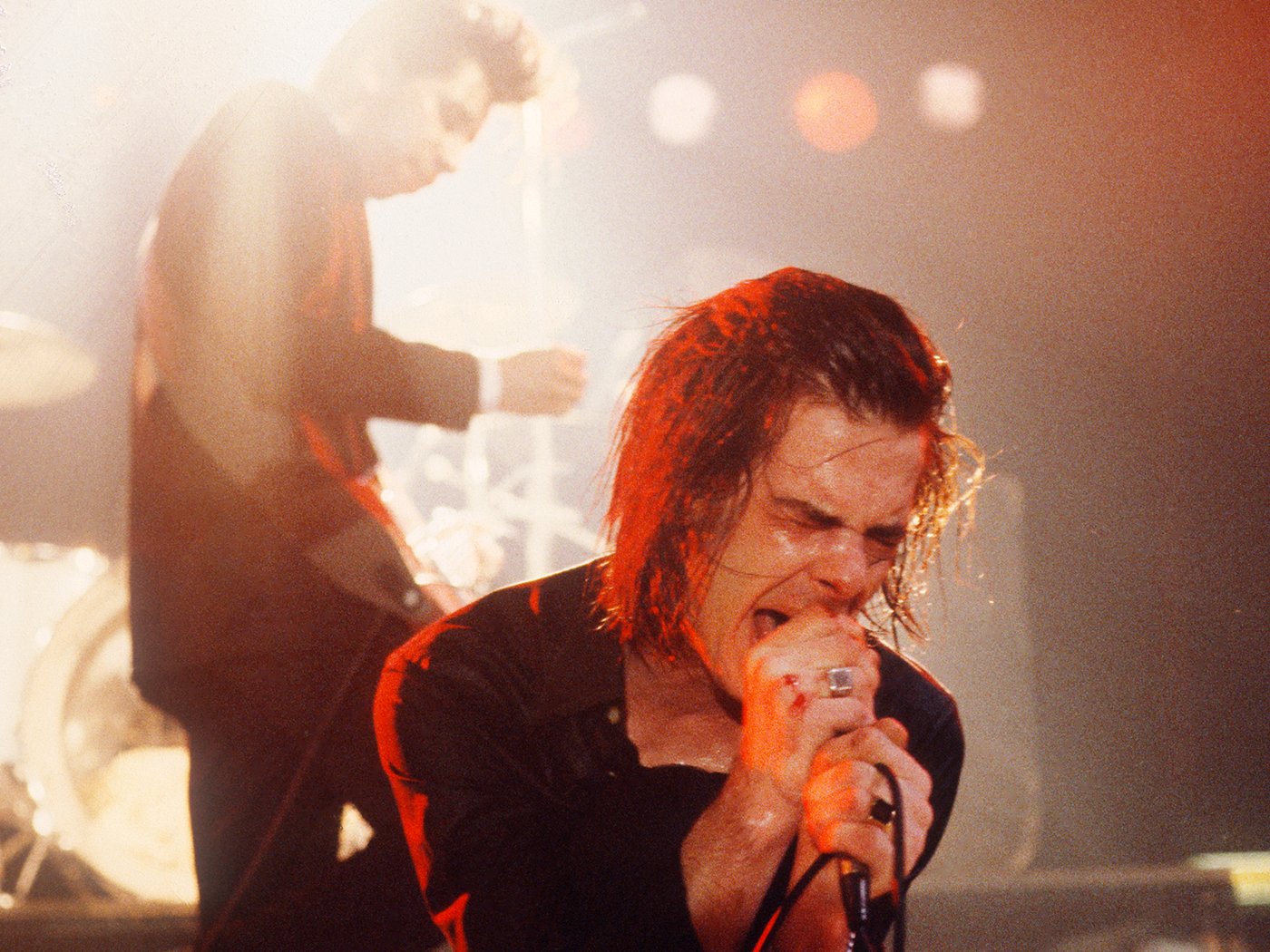
Like all good Australians in their teens and early 20s, Cave found a home in London, arriving just in time to join a new scene that took over a club in Soho: the Batcave. This dark and morbid vibe chimed with Cave’s adversarial approach to life with The Birthday Party. Like most of his peers, he’d balk at the goth label despite dressing solely in black and having exactly the same haircut as Robert Smith, Siouxsie Sioux and Helena Bonham Carter. The Birthday Party traded in bleak, discomforting imagery, with Cave specialising in songs about violence, death and depravity.
Cave later learnt to admire the subculture he unwillingly helped to birth. “That was the bane of our existence when we were young: that we were called a ‘goth band’,” he said in 2023. “It was the last thing you wanted to be called, because we just weren’t. We were a comedy act! But I do have a weird romance for… their capacity to endure.”
The Berlin decadent
As maturity beckoned, but before responsibilities took over, Cave took himself around the world. He moved to Berlin with his new band, The Bad Seeds, where he found a city still living in the shadow of the Wall, ripe for extreme, arty adventures. He was initially lured there by the promise of “cheap drugs, cheap drink and cheap living”, all elements crucial to the creation of great art.
The Bad Seeds thrived in the Berlin underground, even featuring in Wim Wenders’ Wings Of Desire, while Cave’s travels later took him to São Paulo as he fell in and out of love, took lots of drugs and found the space and time to record a series of exceptional albums.
The romantic balladeer
Entering his mid-30s, it was time to take stock and act with a little more dignity. Cave was now rarely seen without a suit, looking like a dapper psycho who’d just stepped out of a gangster film. His music began to evolve as his songwriting switched to piano.
Cave turned out to be a masterful crooner and creator of brooding romantic epics, a style that resulted in two of The Bad Seeds’ most successful albums, Let Love In and Murder Ballads. The latter saw Cave add another string to his bow, collaborating on beauty-and-the-beast duets with Kylie Minogue and Polly Harvey. And when an intense relationship with the latter ended, he channelled his pain into The Boatman’s Call, one of the great break-up albums and one that brought his music to a whole new audience.
The polymath
Happily married and free of addiction, Cave was able to focus his considerable attention on his art. He developed a new approach, sitting at his desk in an office and working nine-to-five, and his productivity went through the roof.
Cave had always been interested in a world beyond popular music, writing his first novel, And The Ass Saw The Angel, in the 1980s while living in Berlin, and the breakthrough success of The Boatman’s Call gave him licence to explore. He wrote a second novel, The Death Of Bunny Munro, acted in The Assassination Of Jesse James By The Coward Robert Ford, wrote the screenplay for The Proposition, collaborated on two operas with Nicholas Lens and created scores for a theatre group in Iceland.
He developed a musical side project, Grinderman, and began writing film and TV soundtracks with Warren Ellis, beginning with The Proposition in 2005. Then there’s the children’s book, the animated short film he narrated, the range of stationery…
Agony uncle
When Nick Cave’s son, Arthur, died in 2015, Cave’s initial response was to pour his grief into his music, most notably Skeleton Tree and Ghosteen. But realising his experience was not unique, he also created a website, The Red Hand Files, in which he would answer questions posed by fans.
While these could concern any subject, Cave’s beliefs, amusing anecdotes, musings on art, politics and creativity, many concerned grief and trauma, as Cave attempted to ease his readers’ pain with often gentle and self-forgiving wisdom.
An artist who had always been aloof and combative was suddenly very present and personal, offering a generous hand to others. Cave took this on tour with a series of one-man shows and into Faith, Hope And Carnage, his book with Sean O’Hagan.
“My son died,” Cave explained. “It changed everything for me. Coming out of punk rock, I had an adversarial, conflicted relationship with my audience, especially in the early days. But after my son died I got an incredible amount of mail from people writing to me with similar experiences. I felt connected to them. I felt like we were suffering together.”
National treasure
Cave would hate this label even more than he did being called a goth, but how else to describe his current status?
It helps that the music remains so intense and powerful. Latest LP Wild God maintains a remarkable streak stretching back to 2013’s Push The Sky Away. But it’s also because he has suffered and grown on the public stage, sharing both his pain and his recovery.
And while we now know more about Cave than we ever did, from his religious faith to his love of wild swimming, the central force that motivates and animates his art remains as mysterious and magical as ever.
National treasure? Without a doubt.
Just don’t expect to see him on Celebrity Traitors any time soon.