
On the surface, John Lennon might have been seen as the Beatle most likely to form a lasting bond with Bob Dylan, such were the often cynical and aloof parallels of their character traits. Yet, it was The Quiet One who became the lifelong pal, and who would persuade the American to be part of his second celebrated chart-topping group.
Bob had met all four Fabs at the same time, on their first visit to the US in 1964, infamously introducing them to the delight of marijuana during an all-night and well into the early hours pow-wow at New York’s Delmonico Hotel. Whenever Dylan subsequently played in the UK, at least one Beatle’s name would be on the guest list, and they made sure he was among the first to hear albums likeRubber SoulandRevolver, tacitly acknowledging the debt they felt their rapidly developing craft owed him.
In his 2026 bookWhere The Music Had To Go: How Bob Dylan And The Beatles Changed Each Other, author Jim Windolf suggests the demands of their respective careers were an obstacle in them ever getting especially close. He also argues that neither Lennon nor McCartney were in the frame to forge any kind of lasting friendship with their contemporary and admirer; John’s outlook and demeanour weretoosimilar, while the ever wary Paul was too competitive.
However, the deeper roots of the Bob and George friendship date from 1968 when Harrison was in the US checking out potential acts to sign to the group’s then fledgling Apple label. Dylan invited him to spend Thanksgiving at his home in Woodstock, upper New York state, and the visit stretched on for several days.
Together they sat, drank, smoked and played guitars, the host still recuperating from a serious motorcycle injury, which George sensed had had a profound effect on Bob’s creativity and confidence. Frequently cited as the most emotionally intuitive of the group, Harrison decided to reach out to his friend in song.
The result was the co-write “I’d Have You Any Time”, later to become the opening track on Harrison’s solo debutAll Things Must Pass, with him singing“Let me say it, let me play it, let me lay it on you/Let me know you, let me show you, Let me grow it on you.”Noticeably, the only one of the album’s 23 tracks that doesn’t originate from George’s pen is Dylan’s own “If Not For You”.
Interviewed for director Martin Scorsese’s 2011 documentaryLiving In The Material World, Harrison’s widow Olivia described Dylan as one of “George’s most important relationships” and that it manifested itself clearly in the song they wrote together. “He was talking directly to Bob because he’d seen him, then seen him another time when he didn’t seem as open. So, that was his way of saying ‘Let me in here. Let me into your heart’.”
Bob isn’t credited as a musician onAll Things Must Pass, and neither is George on the album his pal recorded over the same time period, New Morning. However, when the Brit was spotted dropping by Columbia Studios in New York where sessions were being held,Rolling Stone jumped to conclusions with a news report headlined “Dylan And Harrison Wax LP Together”.
In truth, it was just a social call, albeit one during which, with tapes not always rolling, the buddies jammed on a succession of covers, including Carl Perkins’ “Matchbox” (recorded by The Beatles back in ‘64), The Crystals’ “Da Doo Ron Ron” and Johnny Cash’s “Ghost Riders In The Sky”.
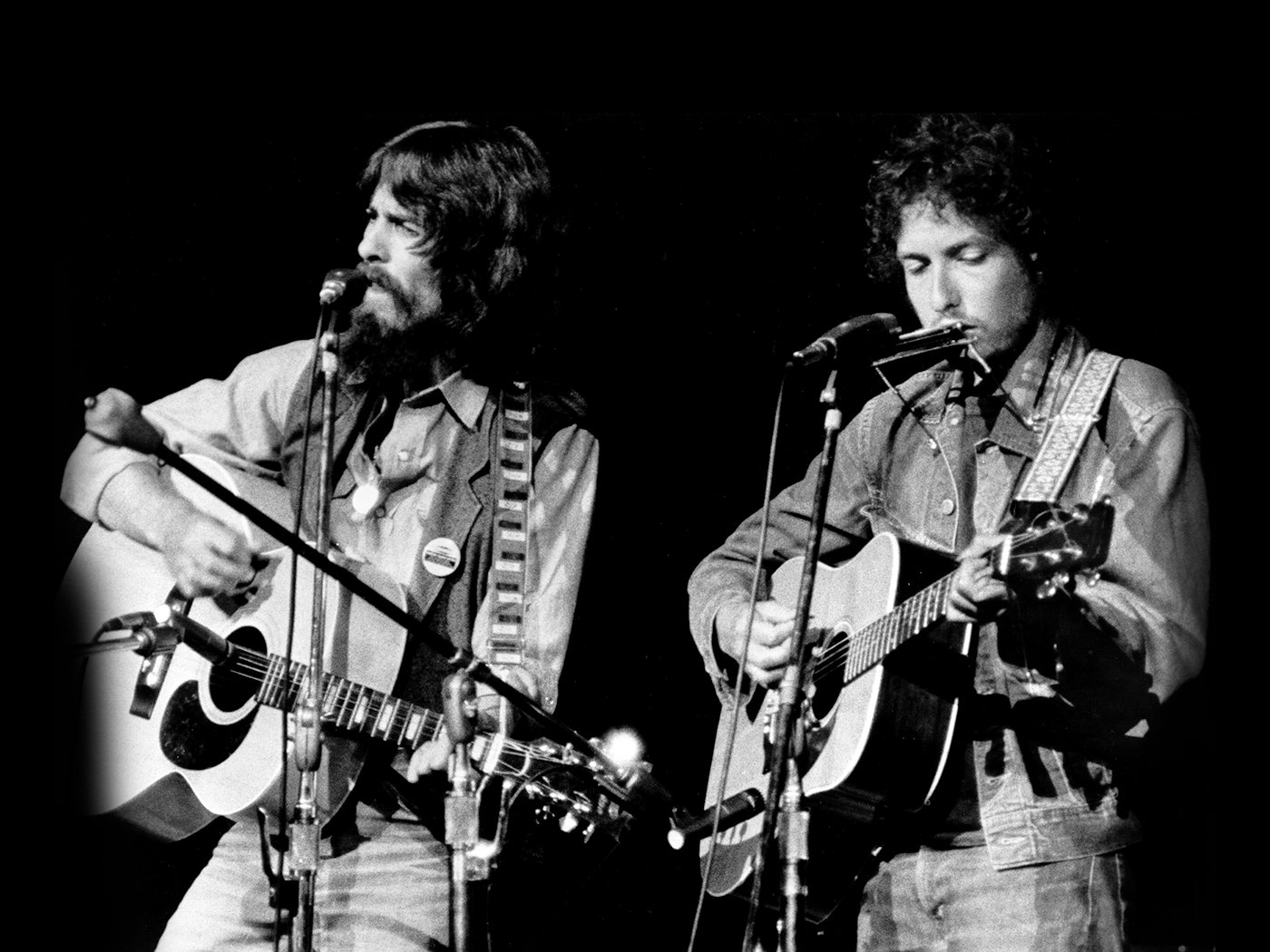
A more visible meeting in New York came about when Harrison put together the multi-act fundraiser Concert for Bangladesh at Madison Square Garden in August ‘71 – the first instance of Bob and a Beatle appearing on record together. An entire side of the commemorative album is devoted to Dylan, poring through his back pages on “A Hard Rain’s A-Gonna Fall”, “Blowin’ In The Wind”, “Mr Tambourine Man” and “Just Like A Woman”, fronting a band featuring not just George, but Ringo Starr and The Band’s Levon Helm.
As Harrison grew ever more reclusive, opting to spend most of his time at his Friar Park mansion, there were fewer instances of the friends getting together, although George ventured out to join Bob onstage in London when he was touring with Tom Petty & The Heartbreakers in October ‘87.
It’s tempting to view that appearance as a teaser for their next collaboration, when Dylan was the missing piece of the puzzle that became the Traveling Wilburys in 1988. In need of a new track for the B side of a single from his albumCloud Nine, George and the record’s producer Jeff Lynne enlisted the services of Tom Petty and Roy Orbison, both of whom Lynne had worked with recently.
Hearing about what sounded like a fun time, Bob offered his home studio in Malibu for the recording, quickly making the jump from host to Lucky Wilbury. It’s likely the most intensive period of time the pair spent together, spawning two full, well-received and big-selling albums. For perhaps the first time, they were collaborators on equal terms rather than superstar contemporaries from adjacent worlds.
George’s spot on the Dylan 30thanniversary show, back at Madison Square Garden in 1992, is considered by most observers as one of the highlights, Harrison cutting a serious rug on
Bob’s “Absolutely Sweet Marie”. It would be the last time they were seen in public together, although Olivia Harrison confirms they stayed in touch regularly, occasionally meeting in person whenever Dylan’s hectic touring schedule allowed.
Given that neither is noted for making themselves easily available to press, radio or TV for interviews, theirs was a bond that, in terms of public declarations, remained largely unspoken. However, following Harrison’s death in 2001,Rolling Stonepublished a heartfelt tribute from Dylan, that spoke more to the man than his music.
“He was a giant,” he wrote. “A great, great soul, with all of the humanity, all of the wit and humour, all of the wisdom, the spirituality, the common sense and compassion for people. He inspired love and had the strength of a hundred men.”